Lemuel's Mother — The Oracle Nobody Can Place
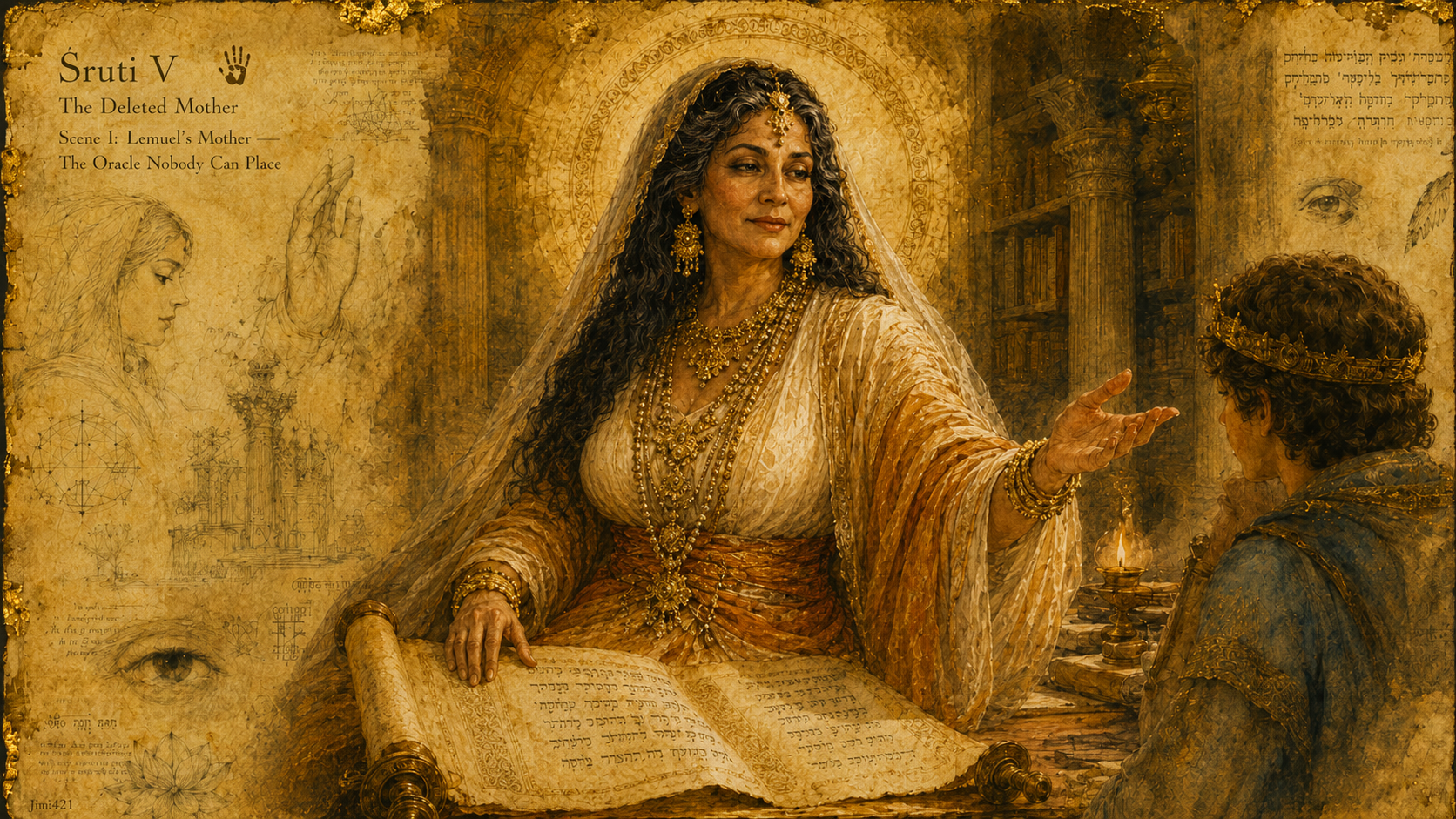
Proverbs 31 opens with a line that most readers pass over without pausing: "The words of King Lemuel, the prophecy that his mother taught him."
The Hebrew word translated as "prophecy" is massa (Strong's 4853) — and this word choice is far more significant than most English translations reveal. Massa appears 66 times in the Old Testament. It is translated as "burden" 57 of those times — a heavy load, a weight placed on the back. When it is used in prophetic literature, it designates the most consequential category of divine revelation: the oracle. Isaiah 13:1 — "The massa of Babylon." Nahum 1:1 — "The massa of Nineveh." Habakkuk 1:1 — "The massa which Habakkuk the prophet saw." Nahum and Habakkuk open their entire prophetic books with this word. It is the formal designation for a divine revelation so heavy that carrying it becomes the prophet's defining burden.
This is the word used for Lemuel's mother. Not māshāl (proverb). Not shīr (song). Massa — the same word that introduces Isaiah's oracle against Babylon and Nahum's oracle against Nineveh. The compilers of Proverbs gave this unnamed woman's teaching the highest prophetic classification available in the Hebrew language. She is not giving advice. She is carrying a divine burden and transmitting it to her son — the same function performed by Isaiah, Nahum, and Habakkuk. The only difference is that she has no book named after her.
And nobody knows who Lemuel is. He appears nowhere else in the Hebrew Bible. No kingdom identified. No genealogy given. No tribal affiliation. Some rabbinical traditions say he is Solomon under another name, but that is a retrofit to make him fit inside a known framework. The simpler reading: he is from outside the Israelite lineage — a king whose mother carried an older transmission that the compilers of Proverbs recognized as too valuable to exclude, even though they could not place its origin.
And the passage she transmits — the Eshet Chayil, the "woman of valour" — reads less like a domestic ideal and more like a cosmic operating principle in human form. She acquires land. She manages international trade. She plants vineyards with the fruit of her hands. She speaks wisdom. She extends her hand to the poor. She runs the household economy while her husband sits at the gates. Her children rise and call her blessed.
A king with no genealogy. A mother with prophetic capacity. An oracle transmitted through the feminine. A text that survived the editorial process because the wisdom was undeniable, even though the editors could not account for where it came from.
This volume asks a simple question: what if Lemuel's mother is not an anomaly — but a survivor? What if the feminine principle in scripture was not always marginal? What if she was once central, and what we are reading now is not the original signal but a degraded translation of it?
The evidence begins 35,000 years ago.
The First Language — Before Writing, Before Words
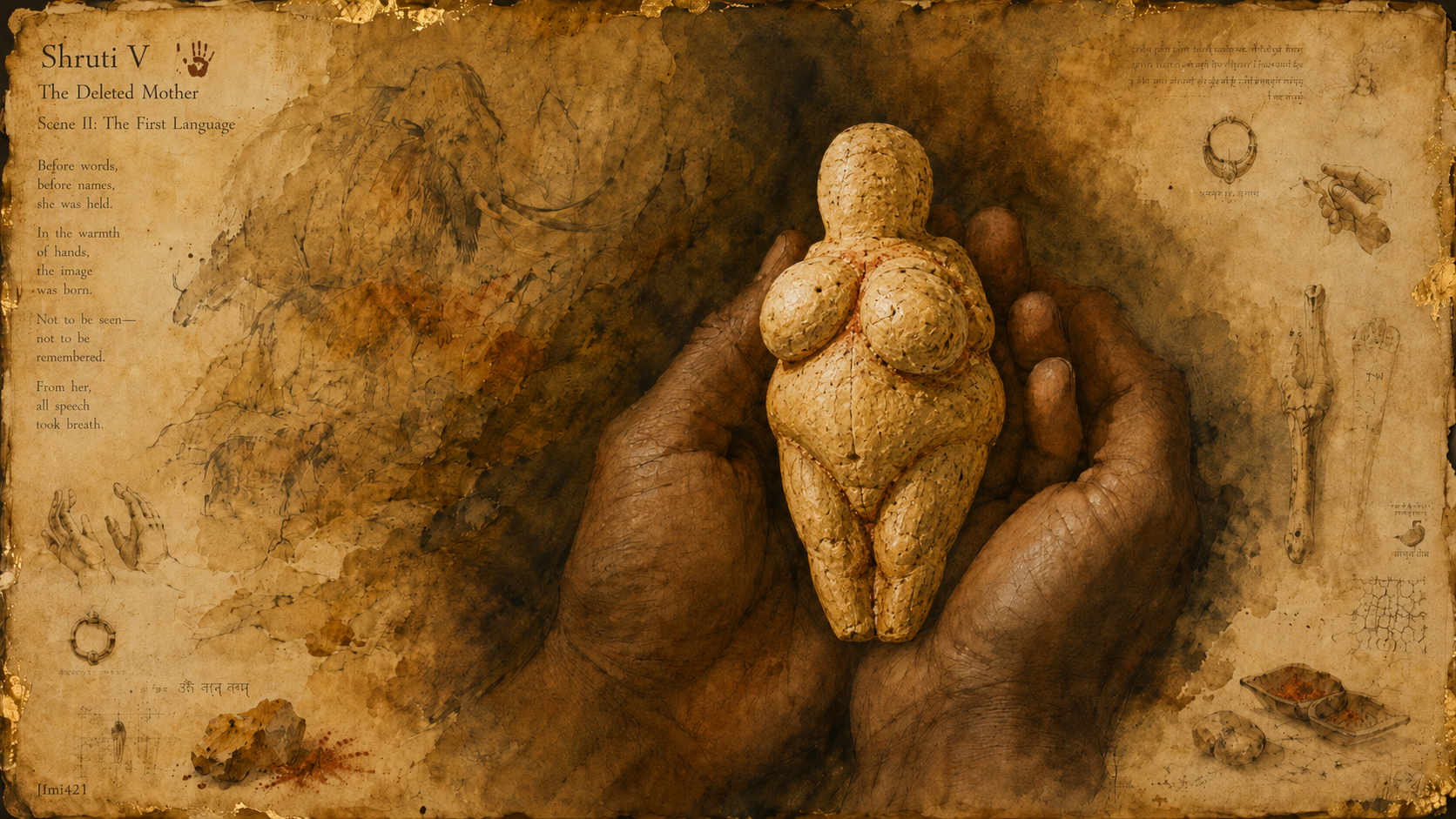
Before anyone wrote a word on clay, before anyone named a god or composed a hymn, someone carved a woman from stone and held her in their hand.
The Venus of Hohle Fels, carved from mammoth ivory in southwestern Germany, dates to at least 35,000 years before the present era — the oldest known figurative sculpture on earth.1 She has no face and no feet. She has exaggerated breasts, a pronounced vulva, and a carved loop where a head might be, suggesting she was worn as a pendant — carried on the body, close to the heart.
She is not alone. Over two hundred similar figurines have been recovered across a span from France to Siberia, most dating to the Gravettian period (26,000–21,000 BCE). The Venus of Willendorf — 30,000 years old, carved from oolitic limestone carried hundreds of miles from its source in northern Italy, tinted with red ochre — is the most recognized. But she is one expression of a continental pattern. These figurines appear across Ice Age Europe from the Pyrenees to the Don River. They were carried by hand by nomadic peoples who valued them enough to transport them across landscapes of ice.
Scholars dispute their meaning. Fertility totems. Self-portraits. Goddess effigies. Nourishment charms. The debate is unresolvable because these peoples left no written commentary. But one fact is not debatable: the first representational art that humans created was the female body. Before anyone carved a man, before anyone carved a god, before anyone carved an animal to worship — someone carved a mother. The creative impulse of the human species, at its earliest recorded moment, reached for the feminine.
This is not a cultural accident. It is a species-level statement about what mattered most. And the 35,000 years of religious history that follow this moment are, in large part, the story of how that original recognition was progressively diminished, translated, abstracted, and eventually deleted from the theological record — one language shift at a time.
The first sculpture was a woman. The last theology is three men.
The distance between those two points is the subject of this volume.
The Oldest Record — Ninhursag and the Rib
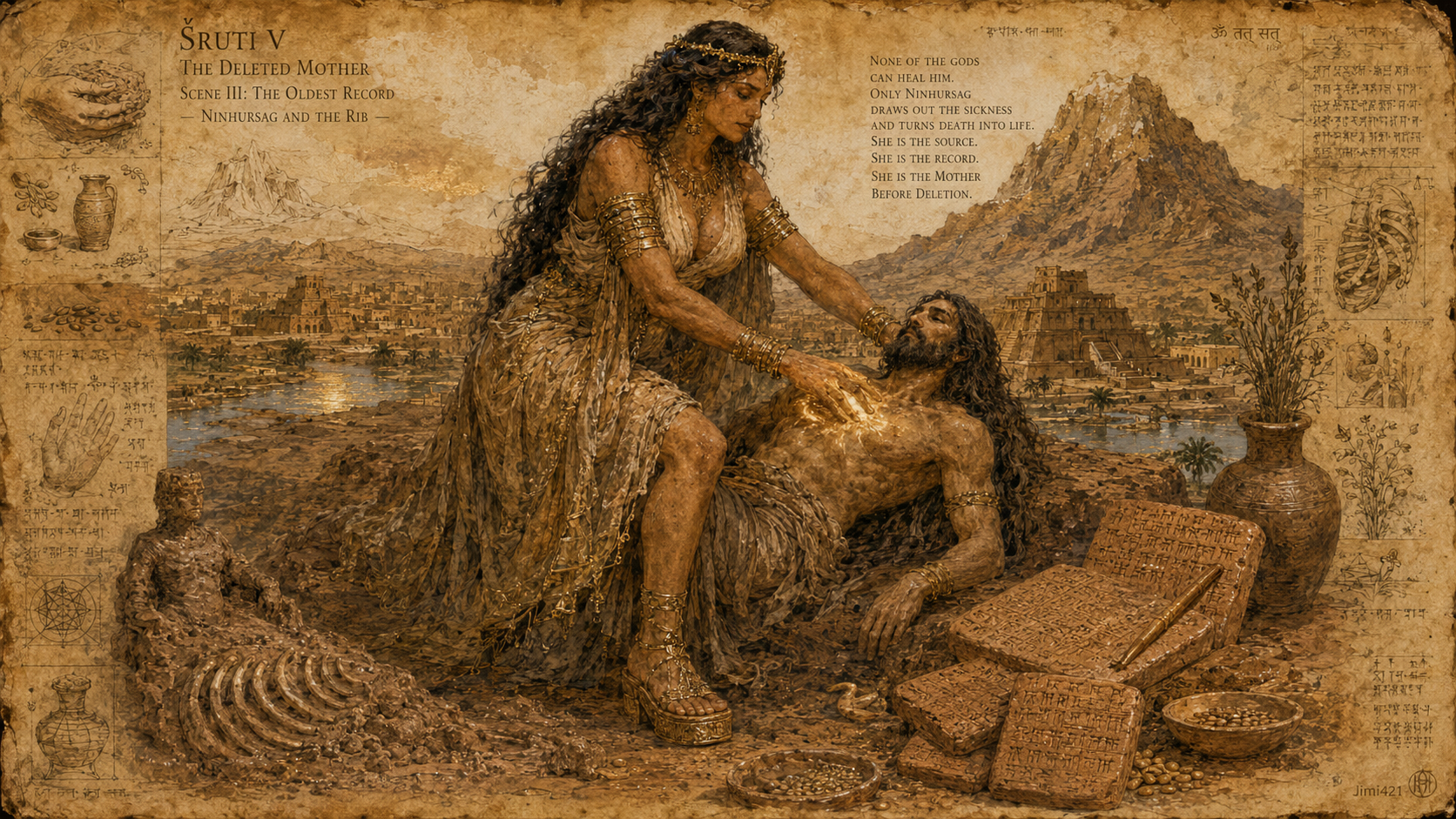
The first civilization to leave written records placed a mother goddess among its four supreme deities. Ninhursag — "Lady of the Sacred Mountain" — stood alongside Anu, Enlil, and Enki in the Sumerian pantheon. The Sumerologist Samuel Noah Kramer noted that "in an earlier day this goddess was probably of even higher rank and her name often preceded that of Enki when the four gods were listed together."2
Her roles were structural, not decorative. She formed humans from clay in the myth of Enki and Ninmah. In the Atrahasis flood narrative, she is chosen by the other gods as the creator of humankind, fashioning mortals from a mixture of divine blood and clay. She was the midwife of gods and humans, the protector of women and children, and the one whose blessing made the land fertile. Worship of the mother goddess figure in Mesopotamia traces back to at least 4500 BCE during the Ubaid Period — before the Sumerians themselves had arrived in southern Mesopotamia.
But the myth that matters most for this volume is Enki and Ninhursag, set in Dilmun — the Sumerian paradise. In this text, Enki's reckless consumption of eight sacred plants brings him to the edge of death. None of the male gods — not Anu, not Enlil, not any god in the assembly — can heal him. Only Ninhursag can draw out the sickness and turn death into life. She gives her own life essence to restore him, and from his eight afflicted organs she births eight healing deities.
One of those organs was his rib. The deity born to heal it was named Nin-ti — and here the text delivers a detail that would echo for four thousand years. The Sumerian word ti means both "rib" and "to make live." So Nin-ti means simultaneously "Lady of the Rib" and "Lady Who Makes Live." It is a bilingual pun — and it is the direct ancestor of Eve, who is both formed from Adam's rib and named "mother of all living" in Genesis 3:20. The pun works in Sumerian. It does not work in Hebrew, where the words for "rib" and "life" are unrelated. The translators carried the image but lost the logic.3
And then the demotion began. Scholars date the declining status of female deities in Mesopotamia to the reign of Hammurabi of Babylon (1792–1750 BCE). By the time the Hebrew Genesis was composed, the mother goddess who created humanity, healed the god of wisdom, and gave her own essence to restore life had been reduced to a secondary character fashioned from a man — rather than the one who fashioned him. The rib survived. The Mother did not.
Sumerian original: Ninhursag creates healing deity from Enki's rib. She is the active principle. He is the patient.
Hebrew adaptation: God creates Eve from Adam's rib. He is the active principle. She is the derivative.
Same image. Reversed polarity. The Mother became the daughter.
Eve and the Second Inversion
But the rib was only the first inversion. The second was worse.
Eve's name in Hebrew — Chavvah (חַוָּה) — means "life-giver" or "mother of all living." That is not a domestic title. That is the same cosmic function carried by Ninhursag, by Śakti, by every mother goddess in every tradition that preserved the original architecture. The name itself remembers what the narrative tried to bury.
And then look at what Eve actually does in Genesis 3. The serpent tells her: "Your eyes will be opened, and you will be like God, knowing good and evil." Eve looks at the tree and sees that it is "good for food, pleasant to the eyes, and desirable to make one wise." She reaches for knowledge. She reaches for gnosis — direct knowing. She is the initiator of humanity's acquisition of divine wisdom.
And the text confirms the serpent was telling the truth. Genesis 3:22 has God himself say: "Behold, the man has become like one of Us, knowing good and evil." The knowledge was real. The transformation was real. Eve's reach was successful.
The theological tradition took this moment — the feminine figure initiating humanity's access to divine knowledge — and made it the original sin. The reason for all human suffering. The reason women should be subordinate. The reason the body is fallen and the flesh is corrupt. 1 Timothy 2:14: "Adam was not deceived, but the woman being deceived, fell into transgression." Centuries of theology built on the premise that the feminine reach for knowledge was the catastrophe.
Read that against Ninhursag. Read that against Sophia in Proverbs 8, who cries out in the streets offering wisdom to anyone who will listen. Read that against the Devī Sūkta of the Ṛg Veda, where the Goddess declares: "I am the sovereign queen, the gatherer-up of treasures, most thoughtful, first of those who merit worship." In every tradition that preserved the original signal, the feminine reaching for knowledge is the gift. In Genesis, it became the crime.
First: The mother goddess who creates from the rib becomes the derivative created from a rib.
Second: The feminine who initiates divine knowledge becomes the sinner who caused the Fall.
Her name still means "life-giver." The text still confirms the knowledge was real. The inversions are visible to anyone who reads closely enough.
Tolkien saw this inversion — and reversed it back. Galadriel is the most powerful being the Fellowship encounters. She maintains an entire realm through her ring Nenya. She sees past, present, and future in her Mirror. She provides the Phial — the light that saves Frodo and Sam in Shelob's lair, the last defence when all other lights go out. And when the Ring is offered to her, she is the one with the wisdom to refuse it. Eve reached for knowledge and was condemned. Galadriel is offered ultimate power — and her refusal is what proves her worthy. Tolkien, the Catholic who attended Mass daily, gave the feminine the moment of supreme moral authority in his epic — and made the masculine figures wise enough to trust her judgement rather than fear it.
The Source Language — Ruach, Pneuma, Spiritus
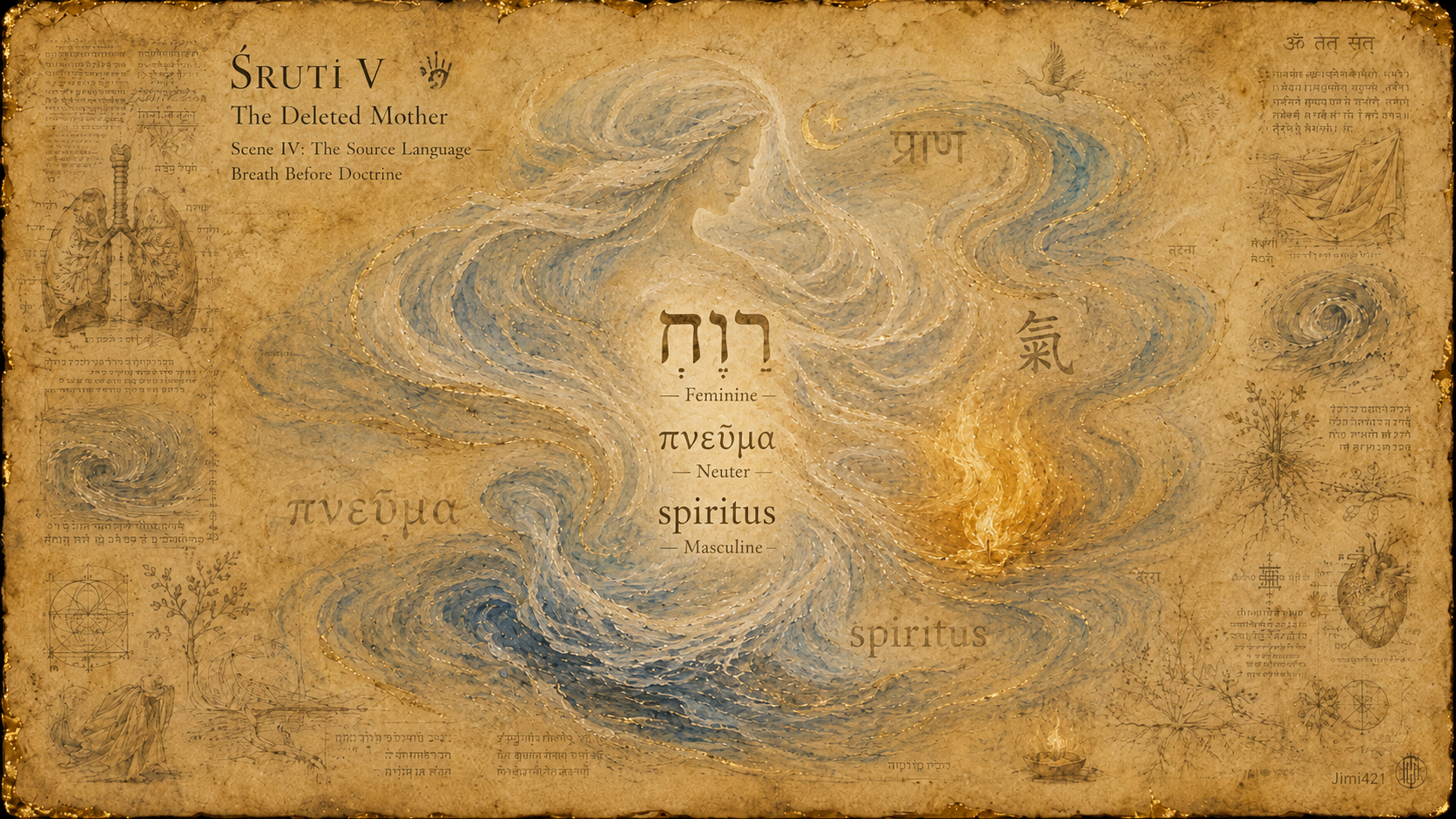
Open Strong's Exhaustive Concordance to entry 7307. The word is rūaḥ (רוּחַ). Part of speech: Noun Feminine. Meaning: spirit, wind, breath. This is the standard lexical classification — not a feminist interpretation, not a mystical reading. It is the grammar of the Hebrew language.
Every time the Hebrew Bible says "the Spirit of God," it uses a feminine noun. Ruach HaKodesh — the Holy Spirit — takes feminine verb forms and feminine adjectives throughout the Old Testament. The Aramaic equivalent — Rucha — is also feminine. This is the language Jesus of Nazareth actually spoke.4
Then the translations began.
When the Hebrew scriptures were rendered into Greek as the Septuagint, rūaḥ became pneuma (πνεῦμα) — a neuter noun. When the Greek was rendered into Latin, pneuma became spiritus — a masculine noun. By the time the Nicene Creed was formalized in Latin at the Council of Constantinople in 381 CE, the formula read: Patrem (Father), Filium (Son), Spiritum Sanctum (Holy Spirit) — three grammatically masculine terms.
Hebrew: Rūaḥ — Feminine
Aramaic: Rūḥā — Feminine
Greek: Pneuma — Neuter
Latin: Spiritus — Masculine
Three translation boundaries. Feminine to neuter to masculine. The same mechanics documented in Vol II — meaning degrades across each transmission boundary. Applied to theology instead of phonology.
The grammatical shift itself was mechanical — each translator working faithfully within their own language. But what happened after the translations existed was not mechanical. The fifth-century suppression of feminine Spirit language in Syriac was a decision made by men in institutional authority. The destruction of the Gnostics was organized violence. The absorption of Sophia into the Logos was a theological committee choosing to subsume the feminine rather than let her stand as co-creator. The grammar opened the door. The councils walked through it. And they walked through it because — as Part VIII of this volume will argue — a population with direct access to the divine feminine is a population that does not need the institution to mediate for them. The translation created the opportunity. Those in power seized it, not in one meeting but across centuries of consistent choices, all pushing in the same direction: remove the feminine, centralize authority.
The result is the creed that billions recite every Sunday, in which the Holy Spirit is called "the Lord, the Giver of Life." Giver of Life is the single most fundamental feminine function in every cosmology on earth. They kept the job description. They erased the gender. And they had reasons.
"She Shall Teach You Everything" — The Syriac Witness
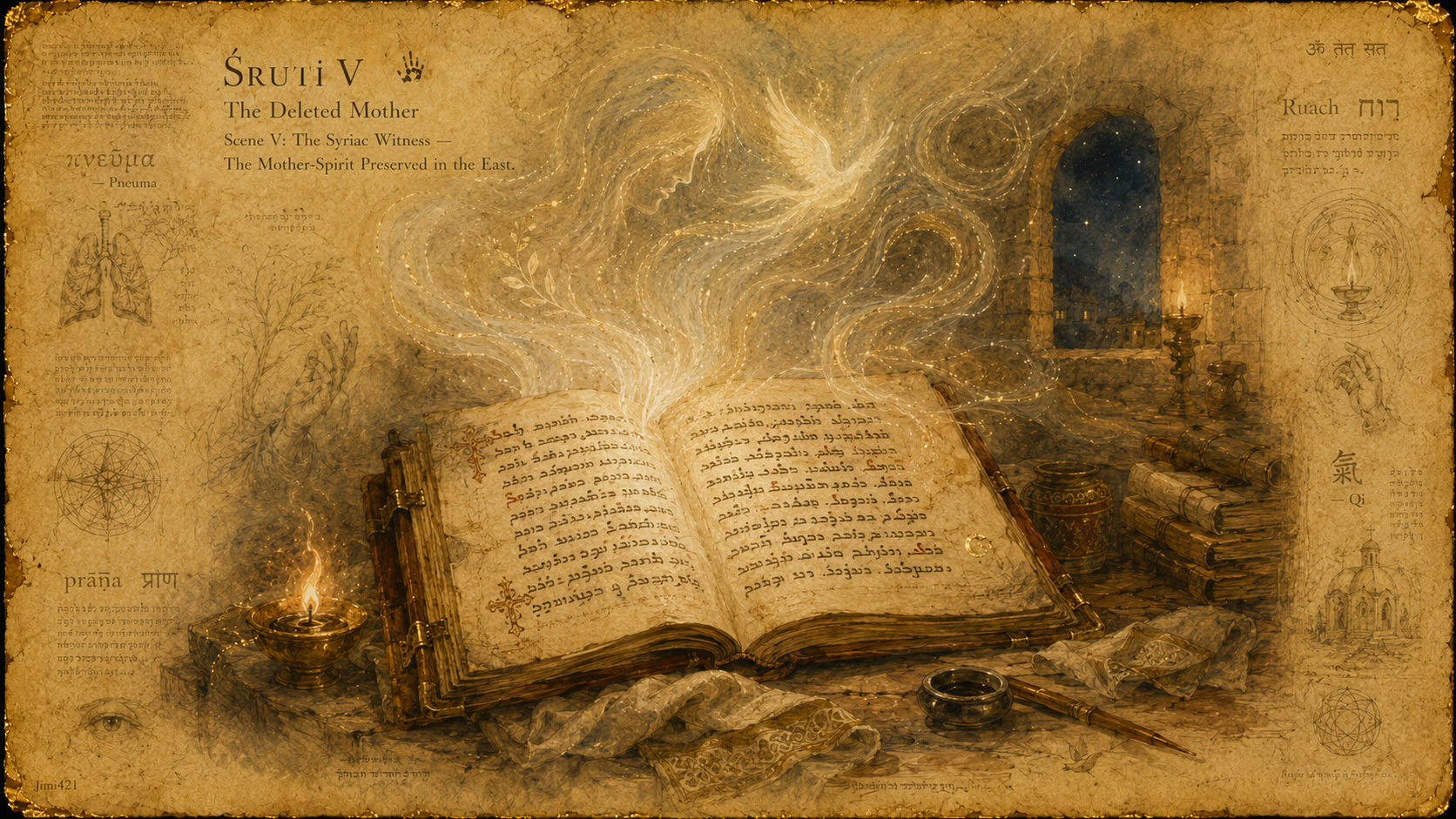
The earliest Christians who spoke a language descended from Aramaic — the language of Jesus himself — knew the Spirit as feminine. This is not a modern reconstruction. It is documented in the oldest surviving Syriac manuscripts.
The Old Syriac Version of the Gospels, reaching back to the second century, translates John 14:26 as follows: "But that Spirit, the Paraclete, that my Father will send to you in my name — She shall teach you everything, She shall remind you of all what I say."5 In the Syriac, the pronoun is hī — "she." Not ambiguous. Not disputed. She.
The Odes of Solomon, a collection of Syriac hymns from the second century, are even more explicit. Ode 36 reads: "The Spirit of the Lord rested upon me, and She lifted me up to heaven… She brought me forth before the face of the Lord." The Spirit is not merely grammatically feminine here. She is a maternal agent — lifting, carrying, presenting.
The Acts of Thomas, composed in Syriac before the mid-third century, invokes the Spirit directly as Mother during the Eucharist: "Come, compassionate Mother… Come, Holy Spirit, and cleanse their loins and their heart, and seal them in the name of the Father and the Son and the Holy Spirit." Father. Son. Mother. The trinitarian formula as these early Christians understood it.
And most striking of all: Jerome, writing in the fourth century, quotes from the Gospel of the Hebrews a passage in which Jesus himself says: "My mother, the Holy Spirit, took me by one of my hairs and carried me to the great mountain Tabor." Jerome records this without scandal. He merely notes that ruach is feminine in Hebrew, masculine in Latin, and neuter in Greek — as though the gender confusion were obvious to anyone paying attention.6
The scholar Sebastian P. Brock, the foremost authority on early Syriac literature, has established that virtually all Syriac literature before 400 CE treats the Spirit grammatically as feminine. In the fourth century, the theologians Aphrahat and Ephrem the Syrian both use maternal imagery for the Spirit. Aphrahat explicitly calls the Spirit "Mother" when commenting on Genesis 2:24.
Then, in the fifth century, the feminine form began to be replaced with the masculine in Syriac texts. By the sixth century, treating the Holy Spirit as masculine had become the enforced norm. It did not disappear because it was wrong. It disappeared because the Greek-speaking institutional church found it inconvenient.
Four hundred years of the Mother. Then silence.
Sophia — The Co-Creator Hiding in Plain Sight
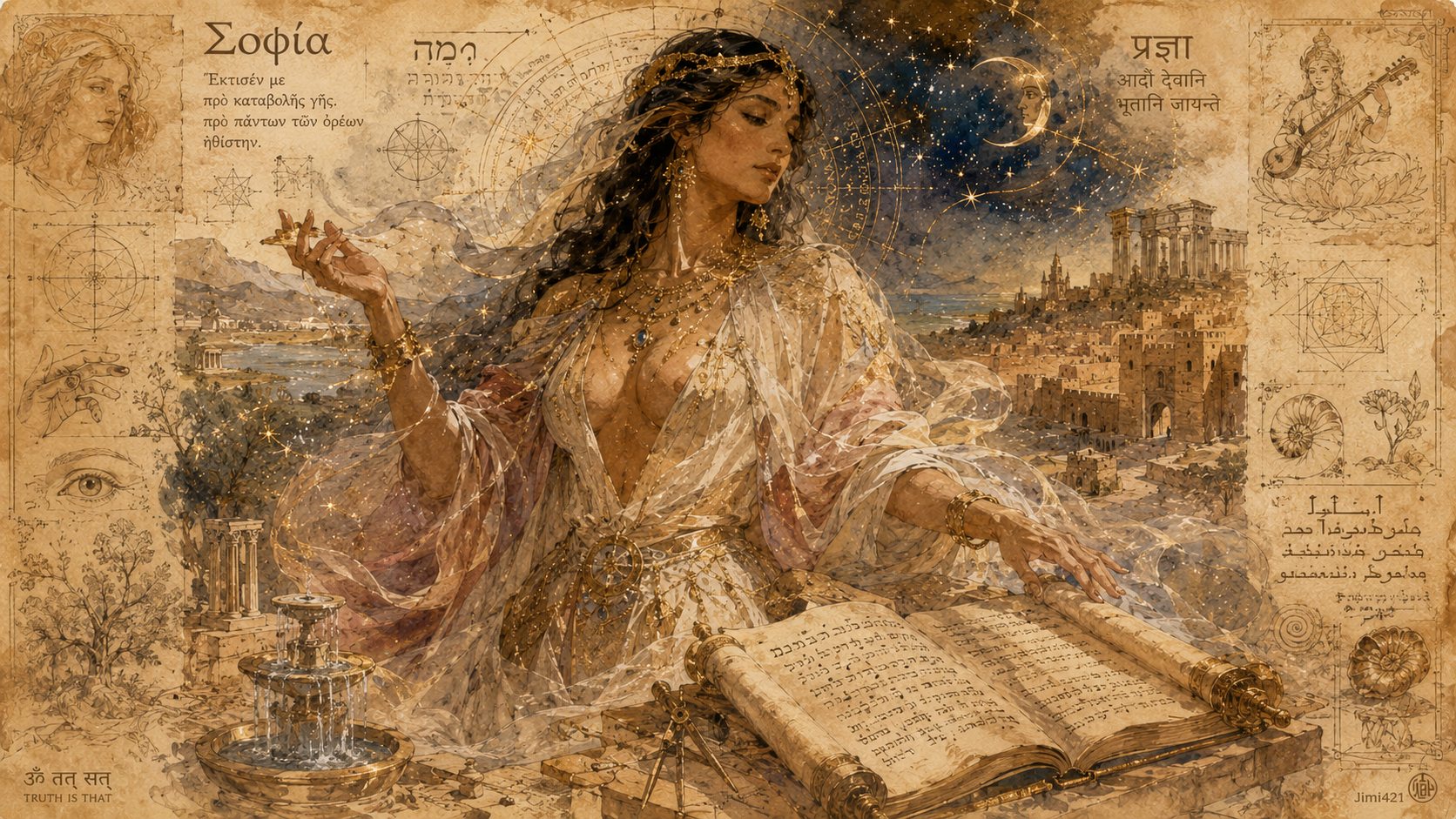
Open a Bible to Proverbs 8. A feminine voice speaks in the first person:
The LORD possessed me in the beginning of his way, before his works of old. I was set up from everlasting, before the beginning of the earth. When he prepared the heavens, I was there. Then I was by him, as a master workman, and I was daily his delight.
Proverbs 8:22–30
The speaker is Chokmah (חָכְמָה) in Hebrew — Sophia (Σοφία) in the Greek Septuagint. Both words mean Wisdom. Both are grammatically feminine. And in this passage, Wisdom is not a metaphor for an attribute. She speaks as a person. She claims to have been present before creation. She describes herself as God's companion — a master craftsman — participating in the making of the world. She is, by any plain reading of the text, a co-creator.
This is not apocryphal. This is not Gnostic. This is canonical Proverbs, accepted by every major Christian and Jewish tradition. And Proverbs 8 is not the only passage. Sophia appears throughout the wisdom literature — and the trail is wider than most churchgoers have ever been told.
The Scriptural Trail
In every Christian and Jewish Bible — the texts that no tradition can dismiss as apocryphal:
Proverbs 1:20–33 — Wisdom cries out in the streets, lifts her voice in the public square: "How long, you simple ones, will you love simplicity?" She warns. She pleads. She speaks with authority.
Proverbs 3:19–20 — "By wisdom the LORD laid the earth's foundations; by understanding he set the heavens in place." She is the instrument of creation.
Proverbs 4:5–9 — "Forsake her not, and she will preserve you. Love her, and she will safeguard you… Exalt her, and she will promote you; she will bring you honor when you embrace her."
Proverbs 7:4 — "Say to wisdom, 'You are my sister,' and call understanding your nearest kin."
Proverbs 8:1–36 — The climactic passage. She speaks in first person. She was present before creation. She was God's companion — his delight — rejoicing always before him. "Whoever finds me finds life." Read the whole chapter.
Proverbs 9:1–6 — "Wisdom has built her house; she has hewn out its seven pillars." She prepares a feast and sends out her maidens. She invites everyone who is simple to come in.
Job 28 — "But where shall wisdom be found? And where is the place of understanding?" She is hidden from all living things. More precious than gold, sapphires, or fine glass. Accessible only through the fear of God.
In Catholic and Orthodox Bibles — accepted as scripture by 1.3 billion Christians:
Sirach (Ecclesiasticus) 24 — Sophia describes herself as coming forth from the mouth of the Most High, covering the earth like a mist, dwelling in the highest heavens, and being commanded by the Creator to make her dwelling in Israel. She is from eternity and fills all that is.
Wisdom of Solomon 7:22–8:1 — The fullest portrait. She is called "the fashioner of all things," described as "a spirit that is intelligent, holy, unique, manifold, subtle, mobile, clear, unpolluted, distinct, invulnerable, loving the good, keen, irresistible, beneficent, humane, steadfast, sure, free from anxiety, all-powerful, overseeing all."
Wisdom 7:25–26 — "She is a breath of the power of God, and a pure emanation of the glory of the Almighty… She is a reflection of eternal light, a spotless mirror of the working of God, and an image of his goodness."
Wisdom 10 — The entire history of Israel retold as Sophia's work. She rescued Adam. She guided Noah. She chose Abraham. She protected Jacob. She accompanied Joseph into slavery. She led Moses through the Exodus. The whole narrative — retold with a feminine subject.
In the New Testament — where Sophia's attributes are transferred to Christ under the masculine term Logos:
John 1:1–18 — "In the beginning was the Word, and the Word was with God." This prologue mirrors Proverbs 8 almost exactly — present at creation, with God, agent through whom all things were made. Scholars widely acknowledge that John's Logos theology draws directly from the Sophia tradition, but substitutes the masculine Greek Logos ("Word") for the feminine Sophia ("Wisdom").
1 Corinthians 1:24, 30 — Christ called "the wisdom of God" (sophia theou). Paul gives the title directly — Christ is Sophia. The feminine principle absorbed into the masculine figure.
Colossians 1:15–17 — Christ as "the firstborn of all creation; for by him all things were created." Language drawn directly from Proverbs 8:22 and Wisdom 7.
Luke 7:35 — "Wisdom is vindicated by all her children." Jesus quotes Sophia in the third person — as though she is someone distinct from himself.
Matthew 11:28–30 — "Come to me, all you who labor and are heavy laden, and I will give you rest." Compare Sirach 24:19: "Come to me, you who desire me, and eat your fill of my fruits." Jesus is speaking Sophia's lines.
The pattern is unmistakable. In the Old Testament, Sophia is a feminine divine person — present at creation, co-creator, guide of Israel's history, inviting humanity to life. In the New Testament, every one of those attributes transfers to Christ under the masculine term Logos. The job description stayed. The gender changed.
The early Gnostic Christians identified Sophia as the feminine aspect of the Godhead — the syzygy of Christ, his divine feminine counterpart. The mainstream Church resolved the problem by absorbing her into the Logos. The Hagia Sophia in Constantinople was dedicated not to a saint named Sophia but to Holy Wisdom — which was then interpreted as an aspect of Christ, not as a feminine divine presence. The name survived. The gender was absorbed.
But every passage cited above is still in every Bible ever printed. She is still speaking in first person. The Hebrew word for her is still feminine. And Jesus is still speaking her lines in Matthew 11.
The Exiled Bride and the Returning Mother
In Kabbalistic Judaism, the Divine Feminine has a name: Shekhinah. The word derives from the Hebrew root meaning "to dwell" and refers to the manifest presence of God in the world. It is a feminine noun. According to Gershom Scholem, the foremost scholar of Jewish mysticism, the identification of the Shekhinah with the feminine was "one of the most important and lasting innovations of Kabbalism — no other element of Kabbalism won such a degree of popular approval."7
In the Zohar, the Shekhinah is the tenth sefirah — Malkuth, the intermediary between the upper realms and the material world. But the Zohar's most powerful myth is the story of her exile. When the Temple was destroyed and Israel driven from the land, the Shekhinah made a choice: she abandoned her spouse — God himself — and went into exile with her children. She refused to remain in heavenly comfort while her children suffered on earth.
That is Kuntī choosing exile with her sons. That is Bhūmi Devī standing before Brahmā on behalf of the earth. The Divine Mother who acts, who chooses, who places her children above her own position. The Lurianic tradition declared that the reunion of God and the Shekhinah — the restoration of the masculine and feminine polarities — was the central task of human spiritual life. Tikkun olam, "repair of the world," is fundamentally about healing this separation.
Tolkien encoded this exile precisely. When the One Ring is destroyed and Sauron falls, Galadriel does not celebrate. She diminishes. She says: "I pass the test. I will diminish, and go into the West, and remain Galadriel." Her power sustained Lothlórien — the most beautiful place remaining in Middle-earth. When she departs, the golden wood begins to fade. The Shekhinah going into exile. Śakti withdrawing. The world becoming diminished not through violence but through the absence of the feminine principle that sustained it.
And then there are the Entwives. The Ents lost them — they searched and never found them. And without the Entwives, the Ents cannot reproduce. They are slowly becoming trees — frozen in place, ceasing to act, ceasing to create. Treebeard's lament for the Entwives is the most melancholy passage in the entire trilogy. The masculine without the feminine does not rage or explode. It just stops. It becomes inert. Without Śakti, Śiva is śava — a corpse. Tolkien arrived at the same conclusion as the Tantric tradition through narrative rather than theology: remove the feminine and the masculine does not die. It simply becomes incapable of anything.
The Reinstallation
When the theology deleted the Mother, the people brought her back.
Across Europe, between 400 and 500 statues and icons of the Black Madonna survive — dark-skinned depictions of the Virgin Mary, concentrated in France, Spain, Italy, Poland, and Germany. Many are housed in crypts, near sacred springs and wells, at sites of pre-Christian goddess worship. Churches named Santa Maria Sopra Minerva — St. Mary on top of the goddess Minerva. Early Madonna figures discovered to be statues of Isis and Horus, repurposed as Mary and the Christ Child.8
At the Council of Ephesus in 431 CE, Mary received the title Theotokos — "Mother of God" — in the city whose principal deity had been Artemis, the great mother goddess whose temple was one of the Seven Wonders. When the council elevated Mary, it also absorbed the sanctuaries of Cybele and Isis that had been closed by Roman-Christian edict.
The Church never made Mary part of the Trinity. But the people pray to her more than they pray to the Holy Spirit. Guadalupe. Fatima. Lourdes. Częstochowa. The people kept reinstalling the Mother from below because the councils had removed her from above. This is not superstition. It is a circuit recognizing that it cannot conduct current without both poles.
The Unbroken Circuit — Śakti, the Breath, and Why They Deleted Her
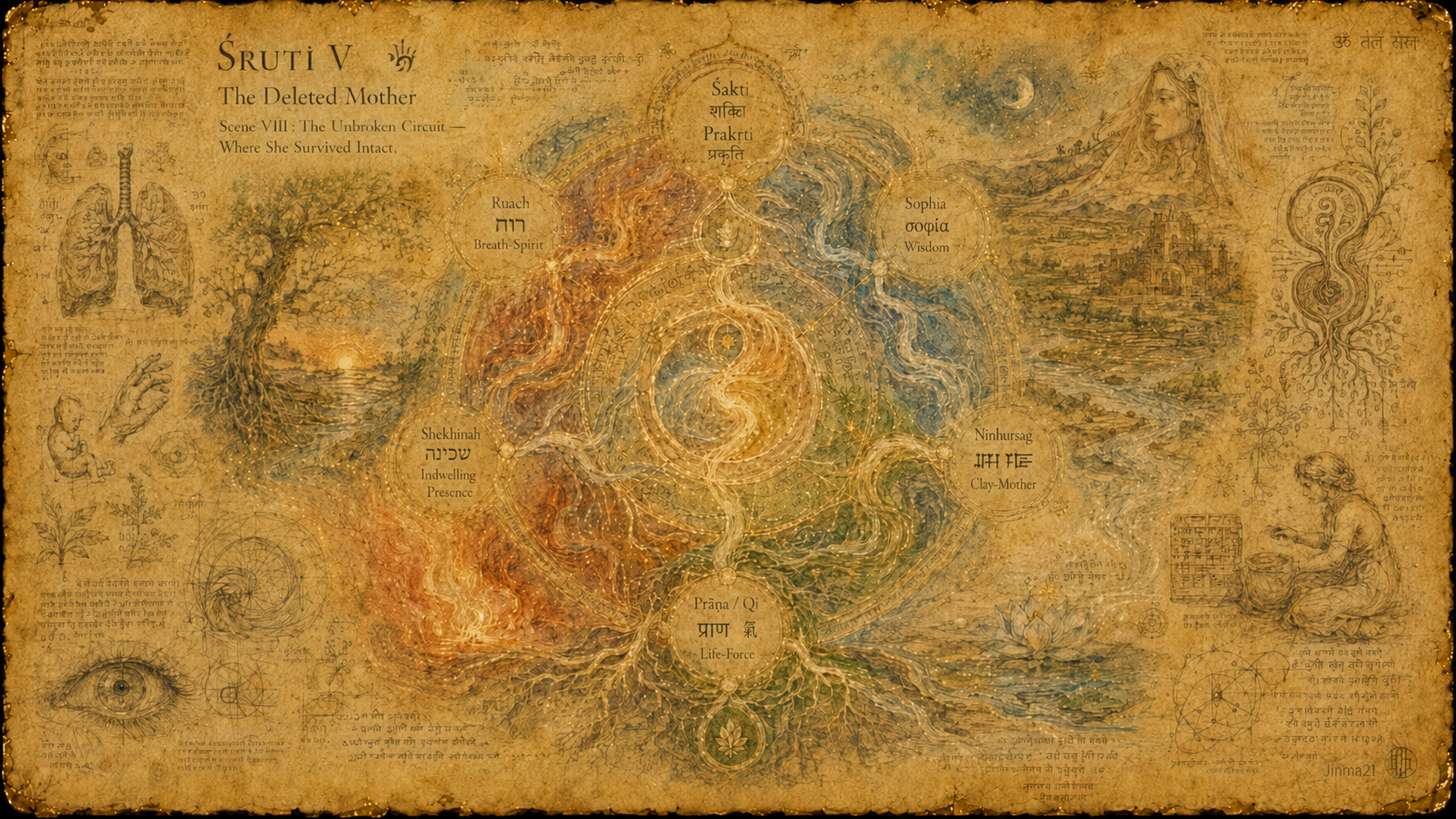
The tradition that preserved the full transmission never deleted her. But it preserved something more than theology. It preserved the technology for experiencing her directly in the body.
In the Vedic and Tantric framework, the feminine is not a supplement to the masculine. She is the engine. Śakti — from the Sanskrit root śak, "to be able" — is the creative power that animates all existence. Puruṣa is pure consciousness — unchanging, unlimited, observing. Prakṛti is nature — active, dynamic, creative. Without Prakṛti, Puruṣa is awareness with nothing to be aware of. Without Śakti, Śiva is śava — a corpse. The Ādi Śaṅkara's Saundaryalaharī opens: "If Śiva is united with Śakti, he is able to create. If he is not, he is incapable even of stirring."
The Devī Upaniṣad states plainly: "I am essentially Brahman." The Devī-Bhāgavata Purāṇa declares: "I am Manifest Divinity, Unmanifest Divinity, and Transcendent Divinity. I am Female; I am Male in the form of Śiva." The Ardhanārīśvara — the half-male, half-female form of Śiva — is not a compromise. It is a technical statement: the divine is inseparable from its own creative power.
The Women Who Carried the War
Look at the women of the Mahābhārata. Kuntī receives mantras that invoke the Devas directly — she is a transmission node. Draupadī is identified as an incarnation of Śrī — sovereignty itself; the entire war rotates around her. Gāndhārī's tapas is so powerful that her curse destroys Krishna's entire lineage. Devakī is the vessel through which the Supreme enters the world. And Bhūmi Devī, as demonstrated in Vol IV, is the earth herself — whose cooperation sustains civilization and whose withdrawal is expressed not as punishment but as physics.
Tolkien's Proof — "I Am No Man"
Tolkien dramatizes this same principle at the climax of his war. The Witch-king of Angmar — the being that no man can kill — is destroyed by Éowyn. "I am no man." That is not merely a battle cry. It is a structural statement: the masculine principle has reached its limit. The threat that every male warrior in Gondor and Rohan could not overcome is overcome by the feminine. Tolkien placed the decisive blow of the Pelennor Fields — the blow that turns the tide of the entire war — in the hands of a woman disguised as a man because the system would not let her fight as herself. She had to break the system to save it. The corridor forced her into disguise. But the architecture required her.
The Breath That Cannot Be Translated Out
But here is what the Vedic tradition preserved that no other surviving system did: the practice.
The Hebrew word for spirit is Rūaḥ — feminine, meaning breath, wind, spirit. The Sanskrit word for life force is Prāṇa — meaning breath, vital energy. The Chinese word for vital energy is Chī (氣) — meaning breath, life force. Three traditions. Three languages. Same word pointing at the same phenomenon: the animating force that moves through the body, that gives life, that was present before the first breath and departs with the last.
Hebrew: Rūaḥ — spirit, breath, wind (feminine)
Sanskrit: Prāṇa — breath, vital force, life energy
Chinese: Chī (氣) — breath, vital energy, life force
Greek: Pneuma — breath, spirit (neuter — the gender already shifting)
Latin: Spiritus — breath, spirit (masculine — the shift complete)
All five words mean breath. All five mean spirit. The linguistic root is the same phenomenon. The theological divergence is what happened next.
In the Vedic tradition, Prāṇa is not a metaphor. It is an observable phenomenon with a technology for working with it directly. Prāṇāyāma — the science of breath regulation — is a systematic practice for experiencing Śakti moving through the body. The chakra system is an anatomical map of how this energy flows. Kuṇḍalinī yoga is the specific discipline for awakening the feminine energy coiled at the base of the spine and guiding it upward through the energy centres to the crown — where Śakti reunites with Śiva. Where the feminine creative power reunites with pure consciousness. Where the circuit completes.
Ramakrishna of Dakshineswar described the movement of this energy in five modes: sometimes it moves like an ant crawling — subtle, barely perceptible. Sometimes like a fish swimming — smooth, fluid. Sometimes like a monkey leaping — sudden, unpredictable. Sometimes like a bird soaring — vast, expansive. Sometimes like a snake winding — rhythmic, spiralling upward through the spine.9 These are not metaphors. They are the diagnostic report of an advanced practitioner describing what he felt in his body during meditation. A phenomenological field report.
Kālī — The Face They Could Not Domesticate
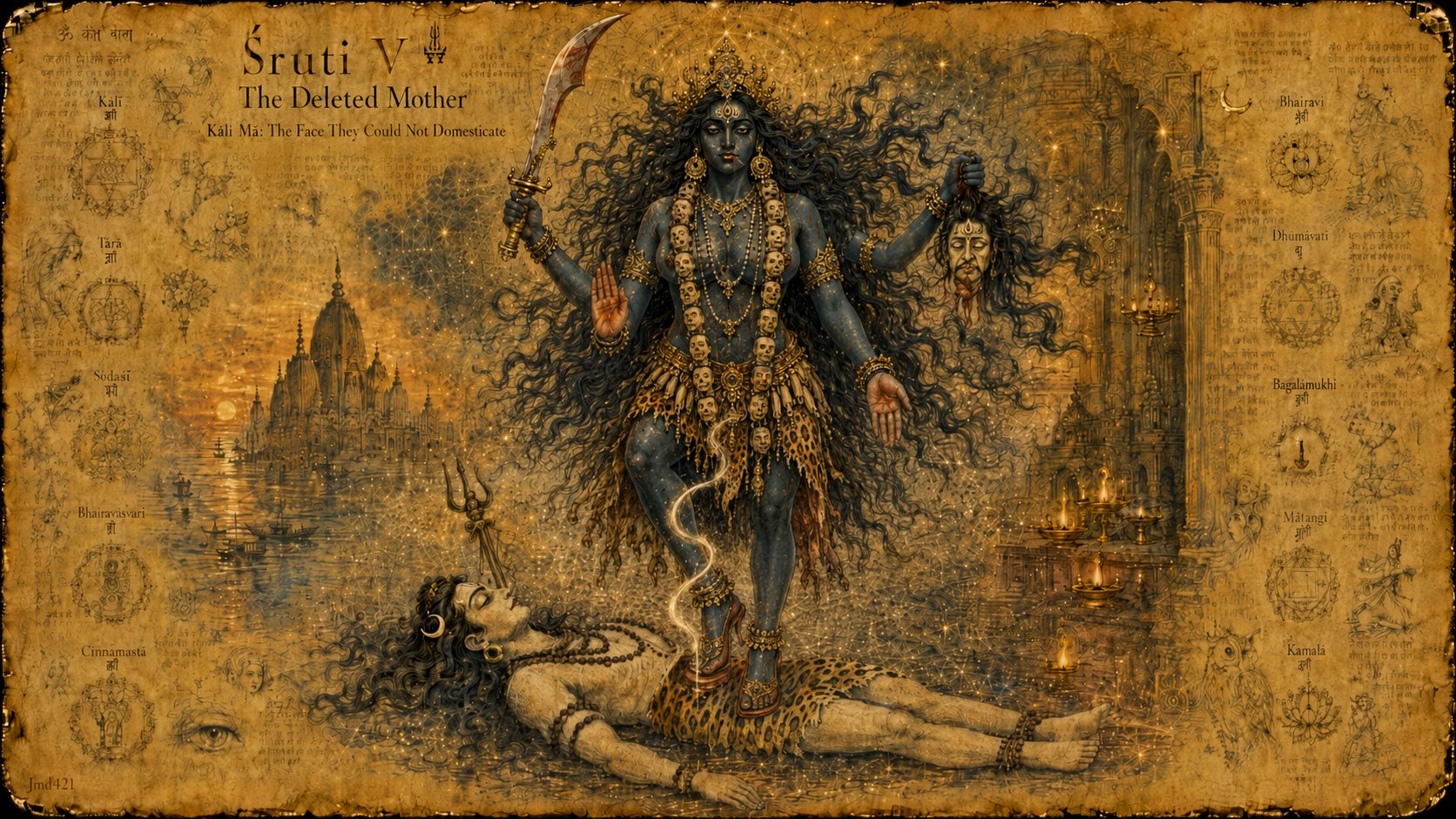
And this is where the Vedic tradition makes its most radical statement. Not in the gentle form of Lakṣmī seated on a lotus. Not in the nurturing form of Pārvatī beside Śiva. But in Kālī — black-skinned, wild-haired, standing on Śiva's chest with a garland of severed heads around her neck, tongue extended, dripping blood. The form that every other tradition would have suppressed, sanitized, or deleted.
The Hindu tradition kept her. And not at the margins — at the centre. Dakshineswar, where Ramakrishna spent his life, is a Kālī temple. His visions, his experiments with Christianity and Islam, his entire spiritual career — all of it emerged from a daily relationship with the most ferocious form of the Divine Mother. He did not start with the gentle Sophia of Proverbs 8 and work his way to the difficult material. He started with Kālī — the form that terrifies — and from that position of total surrender to the most radical feminine, he found that every other tradition was pointing at the same source.
Kālī's name derives from the Sanskrit kāla — time. She is time itself: the force that creates, sustains, and devours all things. Not merely a destroyer. The devourer of time — the one who stands beyond the cycle, who was there before creation and will remain after dissolution. The Devī Māhātmya tells her origin: when the demons Caṇḍa and Muṇḍa attacked the goddess Kauśikī, her fury was so great that her face turned dark — and Kālī emerged from her forehead, fully formed, roaring into the ten directions. She is not born. She erupts. When the situation is desperate enough, the Mother doesn't send help. She becomes something the cosmos has never seen before.
And she is not one face. She is Kālī Mā — the Mother. She is Mahākālī — the Great Time, the ten-armed form who controls all aspects of existence: creation, preservation, and destruction simultaneously. Her skin is the colour of the void before creation — not absence but the pregnant darkness from which all light emerges. Her three eyes see past, present, and future. She is Bhadrakālī — the auspicious dark one. She is Dakṣiṇā Kālī — the benevolent form worshipped in Bengal, right hand raised in blessing. Every form is the same Mother, showing different faces depending on what her children need: protection, destruction, liberation, or love.
She is also the first and supreme of the Daśa Mahāvidyā — the Ten Great Wisdoms, ten forms of the Divine Mother who together represent the complete spectrum of feminine cosmic power. Daśa means ten. Mahā means great. Vidyā means knowledge, wisdom. These are not ten separate goddesses. They are ten faces of one truth — the Divine Mother "sensed in ten different facets." Kālī is the first because she is the most fundamental: the raw power of consciousness before it takes any specific form. From her the other nine emanate — Tārā the guide, Tripura Sundarī the beauty of the three worlds, Bhuvaneśvarī the queen of the universe, and onward — each one a different doorway into the same infinite Mother.
Kālī's iconography is not decorative. It is theological. She stands on Śiva because without her active power he is inert — śava, the corpse. The severed heads are the ego-identifications she cuts away. The blood is the attachment she drains. Her nakedness is the refusal to be clothed in cultural respectability. Her blackness is the void before creation — the śūnya, the emptiness that is not empty but pregnant with all possibility.
Every tradition that deleted the feminine did so by first domesticating her. Eve became the obedient wife. Mary became the virgin. Sophia became an attribute of Christ. The Shekhinah became a metaphor. Each deletion began with making the feminine safe — containable, controllable, unthreatening to institutional authority. Kālī refuses containment. You cannot make her safe. You cannot reduce her to a supporting role. She is standing on God's chest. She is the one who moves. He is the one who lies still. And hundreds of millions of people worship her in exactly this form — not despite the terror but because the terror is the teaching.
The teaching is: the feminine principle is not gentle by default. She is gentle when gentleness serves creation. She is ferocious when ferocity is required. She is the immune system of the cosmos — the force that destroys what has become corrupt so that new life can emerge. The Black Death that Vol IV traces through the corridor? That is Kālī's geography. The AMOC collapse that threatens to withdraw the borrowed heat? That is Bhūmi Devī's patience reaching its limit. The five dwelling places consuming themselves? That is what happens when you run the extractive system long enough for the Mother to respond — not with nurture, but with correction.
The Western tradition could not keep this face. A God who destroys, who is female, who is terrifying, who stands on the masculine and dances — this was incompatible with the institutional requirement for a controllable deity. So they kept the nurturing mother (Mary) and deleted the destroying mother (Kālī). They kept the gentle wisdom (Sophia absorbed into Logos) and deleted the fierce wisdom (Proverbs 1:26 — "I also will laugh at your calamity; I will mock when your terror comes"). They kept the obedient feminine and deleted the sovereign feminine. And in doing so, they lost half the operating system — the half that corrects, that purifies, that burns away what needs to burn so that what remains can live.
The Daoist Parallel — Yin, Yang, and the Circuit That Was Never Broken
The Daoist tradition arrived at the same architecture independently. Yin and Yang are not "female and male" in the Western sense. They are two modes of a single energy: Yin is receptive, still, cool — like Puruṣa, the witnessing consciousness. Yang is active, generating, warm — like Prakṛti, the creative force. The Taijitu symbol has yin inside yang and yang inside yin. They are always already interpenetrating. There is no moment when one exists without the other. That is Ardhanārīśvara as a Chinese diagram. Same circuit, different visual language. And Chī is the medium through which Yin and Yang interact — worked with through qigong, neidan (internal alchemy), and the meridian system — the same breath-energy that the Vedic tradition calls Prāṇa and the Hebrew tradition calls Rūaḥ.
The Vedic tradition kept the theology and the practice. The Daoist tradition kept a parallel practice with a different cosmological frame. The Western tradition kept neither. Western Christianity has no breathwork tradition. No energy body. No map of how the divine feminine moves through the practitioner. The closest it came was the hesychast tradition in Orthodox Christianity — the Prayer of the Heart, synchronized with breathing — and even that was nearly condemned as heresy in the fourteenth century.10
Why They Deleted Her
This is not incidental. The practice was removed because it works.
A population that can sit down, close their eyes, regulate their breath, and directly experience their connection to everything that exists is very difficult to govern through external authority. Very difficult to sell things to. Very difficult to convince that they need an intermediary between themselves and God. Very difficult to march into a war over territory they already know is illusory.
The five dwelling places from Vol IV — gambling, intoxication, lust, slaughter, gold — all of them require a disconnected human. A person who feels the prāṇa moving is not going to gamble compulsively because they already feel abundance. Is not going to seek intoxication because the breath practice already alters consciousness — without dependency, without a supplier, without a market. Is not going to commodify the body because they have felt the body as sacred architecture. Is not going to slaughter carelessly because they have felt the same life force in another being. Is not going to hoard gold because they have touched something gold cannot purchase.
Kali's five dwelling places do not just describe where corruption lives. They describe what fills the vacuum when the practice is removed. Every addiction is a misdirected search for the connection that the practice would have provided. Every empire is built on the labour of people who have been cut off from the inner resource that would have made them ungovernable.
This is why the Gnostics were destroyed. Why every contemplative tradition within Christianity — the Desert Fathers, Meister Eckhart, the Beguines, the Quietists — was pushed to the margins or declared heretical. Not because their theology was wrong. Because their practice was producing direct experience, and direct experience makes institutional authority unnecessary.
The corridor did not just delete the Mother from the theology. It deleted the method for meeting her in the body. And once the method was gone, the theology could say whatever it wanted — because nobody had the experience to contradict it.
Father. Son. Holy Mother.
The circuit that every intact tradition preserves and the corridor translated out.
The Venus figurines say it in stone. Ninhursag says it in clay. Rūaḥ says it in Hebrew grammar. The Syriac Christians say it in the language Jesus spoke. Sophia says it in Proverbs 8. The Shekhinah says it in exile. The Black Madonnas say it from underground crypts and sacred wells. And the Vedic tradition says it without interruption, in continuous practice, from the Ṛg Veda's Devī Sūkta to Navarātri this autumn — where hundreds of millions of people will worship the Goddess for nine consecutive nights without apology, because the tradition that kept the full code never saw any reason to delete half of it.
She was not lost. She was translated out of the theology and deleted from the practice. But the breath cannot be translated out. She lives in the inhale and the exhale. She moves when you sit still enough to feel her. She is the force that Ramakrishna described as ant, fish, monkey, bird, and snake. She is what you feel on the mat and on the cushion when something moves through you that you did not initiate.
The source languages remember. The body remembers. And the breath was never anyone's to delete.
The first sculpture was a mother. The source language is feminine. The breath was never anyone's to delete. And she is moving through you right now.