Before the Split — Babel, Sumer & the Original Tongue
The Mahābhārata is the longest epic poem in human history — approximately 1.8 million words across 18 parvas, composed by Vyāsa over three thousand years ago. It is the story of a great war for dharma fought between two branches of a royal family. The Lord of the Rings is J.R.R. Tolkien's twentieth-century mythology for England — the story of a fellowship's journey to destroy a ring of power before it consumes the world.
Tolkien was a comparative philologist at Oxford who stated plainly: "I am a philologist and all my work is philological." (Letter 205) In "On Fairy-Stories" he wrote that myth and language are "fundamentally, though not in all their characteristics, related" and that mythology is "not a disease of language" but a natural expression of it. He understood that the stories embedded in the roots of words are not decorations — they are structural carriers of meaning. As any serious philologist working with Indo-European etymologies, he would have encountered Sanskrit as the master key for reconstructing the language family that includes Old English, Norse, Gothic, Greek, Latin — every European tongue he drew from.3
The mapping between the Mahābhārata and Lord of the Rings is not coincidence. It points to shared structures preserved across the Indo-European world — structures that both works inherited from the same deep tradition. Tolkien himself wrote that he wished to create "a body of more or less connected legend, ranging from the large and cosmogonic, to the level of romantic fairy-story" for England — a mythology to fill what he called England's "poverty" in native myth. (Letter 131) The materials he used to build that mythology came from the same linguistic river that flows from the Veda.
The Archaeological Record: Sumer and the Indus Valley
The Vedic civilization did not exist in isolation. By the third millennium BCE, the Indus Valley — home to the great cities of Harappa and Mohenjo-daro — was one of the most advanced urban cultures on earth: sophisticated drainage systems, standardized weights and measures, and extensive trade networks reaching Mesopotamia.
Fact: The Sumerians called this civilization Meluhha. Cuneiform tablets from as early as 2350 BCE record Meluhhan ships docking at Akkadian ports. Sargon of Akkad himself boasted that ships from Meluhha, Magan, and Dilmun moored at the quays of his capital. Carnelian beads, lapis lazuli, ivory, and timber moved along these routes. The trade is not speculative — it is documented in the archaeological record on both sides.
Fact: Among thousands of seals excavated from Mohenjo-daro, the Pashupati seal (c. 2500 BCE) depicts a figure seated in what appears to be padmāsana — cross-legged, hands on knees — surrounded by animals. Whatever this figure represents, it is a seated meditative posture carved four and a half thousand years ago.
Fact: Gudea, ruler of the Sumerian city-state of Lagash (c. 2144–2124 BCE), explicitly mentions Meluhha in the Gudea cylinders — the longest known text in the Sumerian language — as a source of materials for his temple-building projects. Look at the Gudea statues in the Louvre: a king in meditative composure, from a city in documented contact with the Indus civilization. The transmission is carved in stone on both sides of the Arabian Sea.
1The Tower of Babel ↔ Indra the Splitter
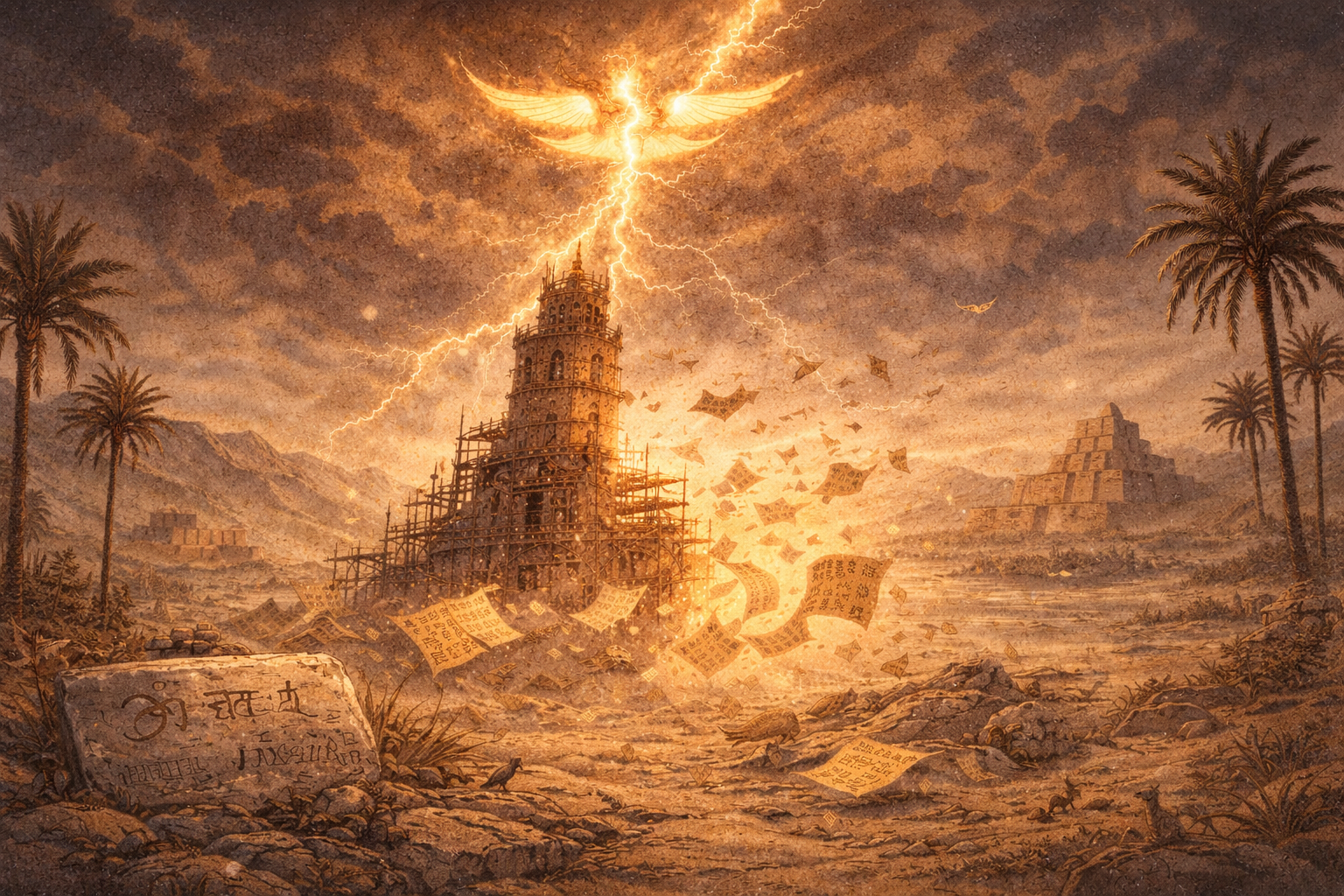
Genesis 11 records a mighty civilization — one language, one people — building a tower to reach heaven. God confuses their language and scatters them across the earth. The Sumerian text Enmerkar and the Lord of Aratta, predating Genesis by over a thousand years, records a parallel account of the confusion of tongues.
In the Vedic tradition, Indra's function is precisely this: he is the splitter. He wields the Vajra — the thunderbolt. He breaks open Vala's cave to release stolen knowledge. He slays Vṛtra to release the waters. His role throughout the Ṛg Veda is to break what has been sealed, to shatter what has become stagnant, to split what has unified beyond its right proportion.
Indra the Enforcer — The Cosmic Circuit Breaker
This is not a one-time event. It is Indra's ongoing function throughout the Vedic literature and the epics. Whenever any being accumulates too much power through austerities (tapas), Indra intervenes. He sends apsarās — celestial maidens — to break concentration. He disrupts yajñas. He sabotages the accumulation of power before it can rival the divine order.
The same pattern appears across every tradition: concentrated power attracts a force that disperses it. Jarāsandha collecting kings, Nimrod building upward, Sauron forging the Ring — each triggers the same structural response. In the Mahābhārata, Krishna, Bhīma, and Arjuna infiltrate Jarāsandha's stronghold disguised as Brāhmaṇas — a small team sent to accomplish what vast armies could not. This is the Fellowship of the Ring: a covert operation against a power too great for open war.
Tolkien dramatizes this structure consciously. The Ring concentrates power. The entire narrative exists to disperse it. Sauron's fall is not military defeat — it is the destruction of the object of concentration itself. Pure Vedic logic: māyā (binding illusion) cannot be defeated by force. It must be unmade.
The Linguistic Bridge — Sanskrit Roots in Tolkien
Tolkien's professional life was spent inside the Indo-European language family. His chair at Oxford was in Anglo-Saxon; his research moved constantly between Old English, Old Norse, Gothic, Finnish, Welsh, and the reconstructed forms of Proto-Indo-European (PIE). For any comparative philologist of his era, Sanskrit was not optional — it was the foundation of the entire discipline.
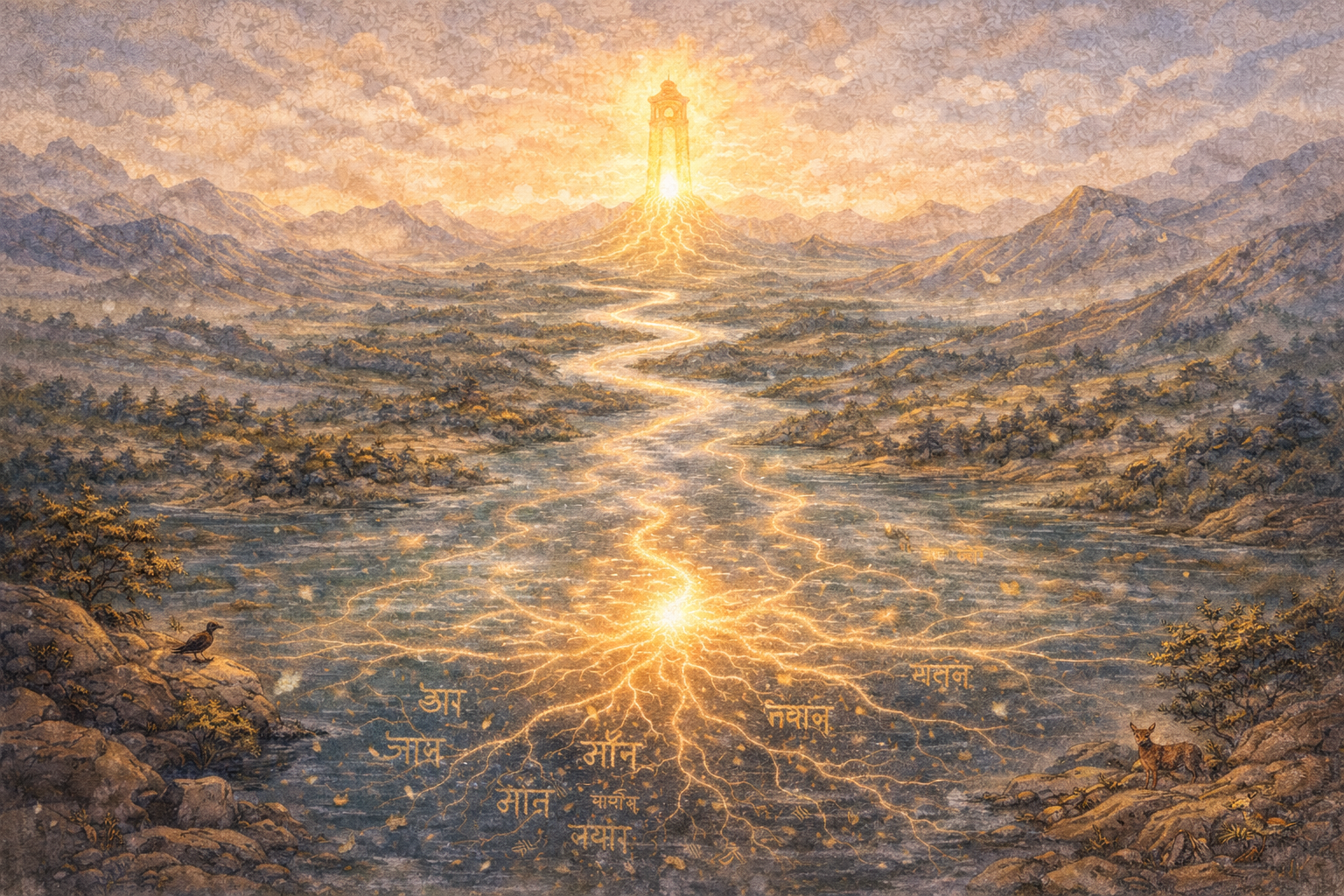
Mark T. Hooker's study Tolkien and Sanskrit (2016) provides the most detailed examination of these connections. Hooker demonstrates that Tolkien calqued the names of the Sapta Sindhavah — the Seven Rivers of the Ṛg Veda — as the Seven Rivers of Ossiriand in The Silmarillion, creating Elvish river names that carry the same semantic content as their Vedic originals.
2Specific Etymological Connections
The following connections operate through documented PIE roots — not surface resemblance:
Saruman / Sūrya. The PIE root *sóh₂wl̥ (sun) branches into both Sanskrit sūrya and the Germanic tradition Tolkien drew from. Saruman's name derives from Old English searu (craft, cunning), but the shared solar root connecting "craft/artifice" with "illumination" runs through the same PIE ancestor.
Brego / Bhṛgu. Bhṛgu is the Vedic ṛṣi clan associated with fire — the "shining ones," credited with bringing fire to humanity. Tolkien's Brego comes from Old English brego (lord, chief). The PIE root *bʰreg- (to shine, to burn) connects them at the deepest recoverable level of the language.
The Danube / Dānu. The river Danube derives from PIE *deh₂nu- (river), which also gives us the Vedic Dānu — the mother of Vṛtra, the serpent Indra slays to release the waters. The same root appears in the Don, Dnieper, and Dniester. European rivers carry Vedic names.
The Language as Architecture
Tolkien did not simply borrow words. He constructed entire languages — Quenya, Sindarin, Khuzdul, the Black Speech — and then derived his stories from the languages rather than the reverse. He modeled Quenya on Finnish and Latin, Sindarin on Welsh. But the deeper architecture — the idea that languages split, drift, and degrade as peoples separate — is itself the central insight of Indo-European comparative linguistics. The Sundering of the Elves dramatizes the PIE dispersal. Tolkien turned philology into mythology.
Character Archetypes — The Warriors of Kurukṣetra in Middle-earth
The character parallels between the Mahābhārata and Lord of the Rings are structural, not superficial. They operate at the level of archetype — the same narrative function carried by figures who face the same moral situations and resolve them through the same dharmic logic. What follows is a mapping of the major figures.
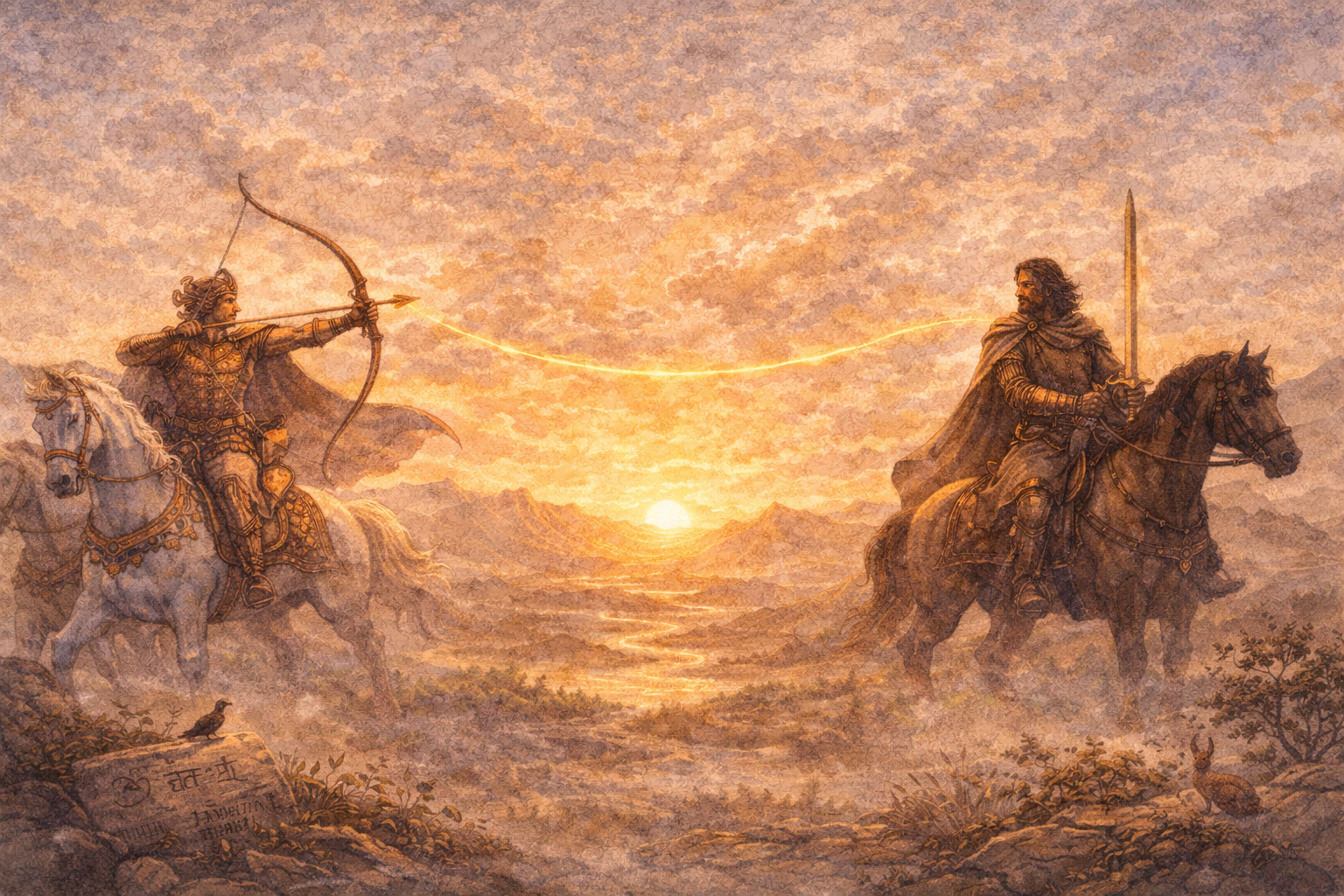
Arjuna ↔ Aragorn
The names share the AR- root (PIE *h₂er-, meaning "to fit together," "noble"). The structural parallels go deeper:
The reluctant king-warrior. Arjuna drops his Gāṇḍīva bow in the chariot at Kurukṣetra and tells Krishna he cannot fight — the crisis that produces the entire Bhagavad Gītā. Aragorn spends decades as Strider, refusing the throne of Gondor, carrying his lineage as a burden rather than a claim. Both are Kṣatriyas who resist the dharma of their birth. Both require divine counsel — Krishna's teaching, Gandalf's guidance — to step into their role.
The exile in the wilderness. Arjuna's years of vanavāsa — thirteen years of exile, the last in disguise — mirror Aragorn's decades as a ranger in the wild. Both master their craft in anonymity. Both return from exile transformed and ready for the war that defines their age.
The divine weapon. Arjuna receives the Pāśupatāstra from Śiva after performing severe austerities, and wields the Gāṇḍīva bow given by Agni. Aragorn receives Andúril — the Flame of the West, reforged from the shards of Narsil. In both cases the weapon is not simply powerful; it is a sign that the wielder has been recognized as worthy by forces larger than himself.
Gandalf ↔ Krishna
Krishna is the charioteer of the Gītā — he does not fight directly but guides the warrior toward right action. This is his deliberate choice: he could annihilate the Kaurava army himself (and demonstrates this capacity in the Viśvarūpa theophany), but the purpose of the incarnation is to teach, not to overpower.
Gandalf operates identically. He is a Maia — a being of immense power who has been explicitly forbidden from matching Sauron's force with force. His role is to counsel, inspire, and hold the line so that mortals can fulfill their own dharma. He does not wield the Ring. He does not destroy the enemy directly. He guides.
The Bhagavad Gītā is delivered on the battlefield, moments before the war begins — the teaching that makes action possible. Gandalf's great speeches serve the same function.
Arjuna ↔ Aragorn — The Exiled Warrior-King
Arjuna is the son of Indra, king of the Devas — a semi-divine warrior of unmatched skill with the bow. He spends thirteen years in exile, including a period of disguise where he conceals his identity and his weapons. During exile he ascends to his father's heaven and receives celestial weapons (Pāśupatāstra from Śiva, the Gāṇḍīva bow that never misses). He is the rightful heir dispossessed by corruption, prepared through exile and austerity for the war that will restore dharmic order.4
Aragorn is the heir of Isildur, descendant of Elros — carrying divine blood through the line of the Half-elven. He wanders for decades under aliases (Strider, Thorongil), concealing his lineage and his weapon — the shards of Narsil, reforged as Andúril when the time comes. Both figures carry the same archetype: the semi-divine warrior stripped of status, refined through exile, returned to claim what was always theirs. The exile is not misfortune. It is tapas — austerity that burns away the false so the true can manifest.
Gandalf the Grey dies in Moria and returns as Gandalf the White — the ascent through levels of consciousness. Sri Aurobindo describes exactly this process: the lower formation must be shed before the higher can manifest. Gandalf is not a warrior. He is a conduit for light breaking through.
And like Krishna, Gandalf operates under constraints. Krishna chooses to be Arjuna's charioteer — not his general. He wields no weapon at Kurukṣetra. His power is vast but self-limited. Gandalf is an Istar — a Maia sent in mortal form, explicitly forbidden from matching Sauron's power with power. Both are divine beings who enter the mortal arena under rules that prevent them from simply solving the problem. They must teach, guide, inspire — but the action must be taken by the mortal warriors themselves. This is the Aṃśāvatāra logic documented in Vol IV: divine beings deployed under mortal constraints, carrying enough power to shift the balance but not enough to bypass free will.
Sam ↔ Hanumān
Hanumān is Rāma's most devoted servant — his bhakta. He carries Rāma in his heart (literally, in the famous image where he tears open his chest to reveal Rāma and Sītā within). He crosses the ocean, enters the enemy's fortress, finds the captive, and returns — not through superior power but through unwavering devotion.
Samwise Gamgee carries Frodo up Mount Doom. He enters Mordor. He faces Shelob. He does none of this because he is powerful. He does it because his devotion is absolute. Tolkien called Sam "the chief hero" of the story. This is Bhakti Yoga — the path where love is the actual weapon, and the devoted servant accomplishes what the mighty cannot.
Gimli ↔ Bhīma
Bhīma fights with the gadā — the mace — and with raw physical power. He is the strongest of the Pāṇḍavas, blunt where Arjuna is precise, unstoppable where Nakula is graceful. Gimli with his axe fills the same narrative position: the stout warrior of enormous strength, lacking elegance, devastating in close combat. Neither is subtle. Both are indispensable.
Legolas ↔ Nakula
Nakula is described as the most handsome man on the battlefield — son of the Aśvins, the celestial twin physicians. Legolas carries that same otherworldly beauty. As an Elf, he occupies a Gandharva-type position — a being of celestial grace, superhuman perception, and an aesthetic refinement that belongs to a higher plane of existence.
Wormtongue ↔ Shakuni
Shakuni is the whispering uncle who corrupts Duryodhana and, through him, the blind king Dhṛtarāṣṭra. Gríma Wormtongue poisons Théoden in almost exactly the same way — the cunning advisor who gains control by whispering corruption into a weakened king's ear. Both courts are paralyzed from within by a figure who never holds the throne but controls the one who does.
Boromir ↔ Karṇa
Karṇa is the greatest warrior on the wrong side — noble, generous, bound by loyalty to Duryodhana even though he knows the Pāṇḍavas' cause is just. His tragedy is that his virtues — loyalty, courage, honor — bind him to adharma. Boromir falls to the Ring's temptation not because he is weak but because his desire to save Gondor is genuine. Both are undone by the very qualities that make them admirable. Both die in the service of a cause that was not entirely their own.
Gollum ↔ Aśvatthāmā
Aśvatthāmā is cursed at the end of the Mahābhārata to wander the earth for three thousand years — immortal but decaying, covered in sores and wounds that never heal, carrying a jewel torn from his forehead. Gollum is the same archetype: the Ring extends his life unnaturally across five centuries, but he does not live. He decays. He forgets his name. He becomes a creature of pure attachment.
Gollum destroys the Ring — not Frodo. The most fallen being accidentally fulfills the cosmic purpose. This is pure Mahābhārata logic: even adharma serves dharma in the end. Krishna manipulates the entire war through figures who don't understand their own role. The cosmic design works through the most unexpected instruments — and the most damaged.
Cosmological Mapping — The Worlds Within the World
The character parallels are surface-level evidence. The deeper mapping is cosmological — the structure of the worlds themselves, the types of beings that populate them, and the objects that bind them.
Elves ↔ Gandharvas
The Gandharvas are celestial beings — beautiful, musical, ancient, inhabiting higher planes. They serve as cosmic musicians and messengers between realms. The Elves of Middle-earth carry every one of these attributes: immortal, impossibly beautiful, masters of song and craft, dwelling in enchanted places where time moves differently. Rivendell and Lothlórien have the quality of Gandharva-loka — realms that exist alongside the mortal world but operate on a different frequency. The Elves leaving Middle-earth at the end of the Third Age mirrors the Gandharvas dwelling in celestial realms beyond mortal reach.
Orcs ↔ Rākṣasas
In the Silmarillion, Orcs were originally Elves captured and corrupted by Morgoth — beings that were once something luminous, twisted by dark power into instruments of destruction. Rākṣasas in the Vedic and epic tradition are similarly powerful beings who have turned toward adharma — not inherently demonic but corrupted, operating in opposition to the divine order. Both are defined not by what they are but by what they were.
Ents ↔ Yakṣas
In the Vana Parva of the Mahābhārata, a Yakṣa guards a sacred lake and kills Yudhiṣṭhira's brothers one by one when they refuse to answer his riddles before drinking. The Yakṣa is patient, ancient, and lethal when disrespected — a guardian of nature's law. Treebeard and the Ents fulfill exactly this function: ancient beyond reckoning, patient to the point of seeming inert, and devastating when finally roused. The destruction of Isengard by the Ents is a Yakṣa awakened.
The One Ring ↔ Māyā
The One Ring functions as māyā in its technical Vedāntic sense — the binding illusion that entraps consciousness in attachment and identification with power. Everyone who touches it becomes attached. It does not make them strong; it makes them bound. This is the Gītā's core teaching: attachment (rāga) is the root of suffering and destruction. The Ring does not corrupt through evil — it corrupts through desire. Boromir wants it to save Gondor. Galadriel imagines using it for good. The mechanism is kāma (desire) operating through māyā (illusion).
Mūmakil ↔ Vedic War Elephants
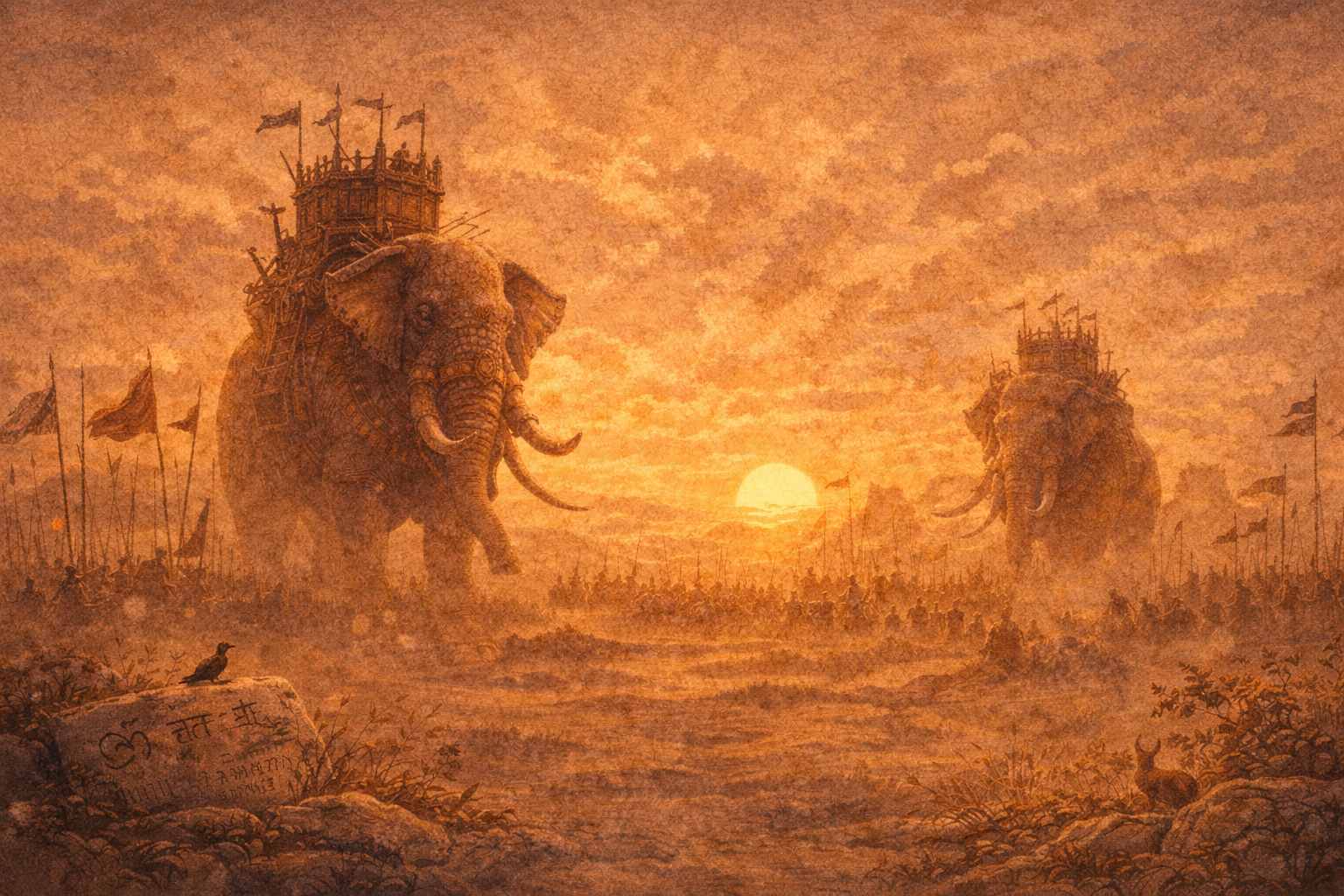
There have been no elephants in Europe since the Pleistocene. Yet Tolkien places massive war elephants — the Mūmakil — at the Battle of the Pelennor Fields. In the Mahābhārata, the standard military formation (akṣauhiṇī) is precisely calibrated: 1 chariot, 1 elephant, 3 cavalry, 5 infantry. War elephants are central to the Vedic and Indian military imagination and entirely absent from the European one. The Mūmakil are, in structural terms, an Indian import — a Vedic military element appearing in a supposedly European mythology.
The Undying Lands ↔ Brahmaloka
The Undying Lands — Valinor, the Blessed Realm — are not heaven in the Christian sense. They are a realm that exists within the created world but beyond mortal reach, where the Valar dwell and where the Elves may return. This maps to Brahmaloka in Vedic cosmology: the highest realm within saṃsāra, luminous and blissful, but still within the created order — not ultimate liberation (mokṣa). Even Valinor was created by Ilúvatar. Even Brahmaloka exists within the cycle.
Divine Signs & Battlefield Omens
Both epics share a conviction that the battlefield is not merely a physical space — it is a field where cosmic forces express themselves through visible signs. Thunder, portents, celestial interventions — these are not decorative. They are structural elements that signal the presence of dharmic forces operating through human events.
Thunder Before Helm's Deep ↔ Indra Watching His Son
Before Helm's Deep, thunder rolls across the sky. As lightning reveals ten thousand Uruk-hai, Legolas turns to Aragorn and says: "Your friends are with you, Aragorn."
An Elf — a Gandharva-type being, celestial in perception — senses what mortals cannot. He does not say "we" are with you. He says "your friends." The lightning just spoke. The thunder just rolled. And the being most attuned to the unseen world names what just happened: something beyond the physical battlefield is present.
In the Mahābhārata, when Arjuna enters battle, Indra sends thunder and celestial signs. Indra is king of the Devas, lord of storms — and Arjuna's biological father. Arjuna is Aindri, son of Indra. Every time thunder rolls before Arjuna fights, it is his father watching from above. The parallels between Aragorn at Helm's Deep and Arjuna at Kurukṣetra — the storm, the celestial witness, the warrior standing against impossible odds — operate on the same symbolic grammar.
The Gītā Before Battle ↔ The Council of Elrond
The Bhagavad Gītā is delivered between the two armies, after the conches have blown but before the first arrow flies. Arjuna, the supreme warrior, drops his bow and says: "I will not fight." (Gītā 2.9) He sees his teachers, his cousins, his grandfather Bhīṣma on the opposing side and is paralyzed by grief. The greatest archer in the world becomes unable to lift his weapon — not from cowardice but from moral clarity. He sees the cost of what is about to happen.
Krishna does not command him to fight. He teaches him. For eighteen chapters — 700 verses — Krishna unfolds the nature of reality, the structure of the self, the meaning of action, the relationship between the individual and the absolute. He teaches Karma Yoga (right action without attachment to results), Bhakti Yoga (devotion), and Jñāna Yoga (knowledge). He reveals his cosmic form — the Viśvarūpa — and Arjuna sees that everything that will happen has already happened inside the divine. The teaching does not make the war easier. It makes the war meaningful.
The Council of Elrond serves the same narrative function at the same structural position. Before the quest begins, the full weight of what is at stake is laid bare. The Ring is displayed. The histories are recounted. Every alternative is considered and rejected. The impossibility of the task is acknowledged by everyone in the room — warriors, wizards, kings, Elves. And then the smallest, least powerful being in the room says: "I will take it, though I do not know the way."
Arjuna says "I will not fight" and receives the teaching that enables him to fight. Frodo says "I will take it" and receives the fellowship that enables him to carry it. Both moments are hinges — the point where the entire epic pivots from paralysis to action. And in both cases, the pivot is not strength arriving. It is understanding arriving. Arjuna understands the nature of dharma. Frodo understands that the burden must be carried by the one least likely to be corrupted by it. Neither moment is about power. Both are about perception clearing.
Setting: Gītā — the battlefield at Kurukṣetra, between two armies. Council — Rivendell, with representatives of every free people.
Crisis: Gītā — Arjuna sees his family on both sides and refuses to act. Council — the Ring is revealed and nobody wants to carry it.
Teaching: Gītā — Krishna explains reality for 18 chapters. Council — Elrond, Gandalf, and the histories explain the Ring's nature and the stakes.
Pivot: Gītā — "I will fight" (11.33). Council — "I will take it" (Frodo).
Result: Gītā — right action becomes possible through understanding. Council — the quest becomes possible through acceptance.
Same architecture. The teaching precedes the action. The understanding enables the sacrifice.
And Gandalf's great line — "All we have to decide is what to do with the time that is given us" — could sit comfortably in any translation of the Gītā. Compare Krishna's words in Chapter 2, Verse 47: "You have a right to perform your duty, but you are not entitled to the fruits of your actions." Both are saying the same thing: act from clarity, not from calculation. Do what is right because it is right, not because you expect a particular outcome. This is niṣkāma karma — selfless action — and it is the operating instruction of both epics.2
Celestial Weapons and Light in Darkness
The Phial of Galadriel — "a light when all other lights go out" — carries the light of Eärendil's star, which contains the light of the Silmarils, which contain the light of the Two Trees. It is concentrated, inherited radiance — light passed down through increasingly diminished vessels. The Vedic concept of tejas — spiritual fire, luminous power — operates identically: it can be stored, transferred, concentrated, and inherited. When Frodo raises the Phial against Shelob, he is wielding tejas.
If Sakka, lord of the devas, will be one who speaks in praise of initiative and energy, then how much more fitting for you to toil, struggle, and strive.
— The Buddha, Sakka Saṃyutta
Light vs. Darkness — The Vedic Psychology of Middle-earth
The moral framework of the Mahābhārata is not "good vs. evil" in the Western binary sense. It operates on a spectrum: jyoti (light, consciousness, clarity) against tamas (darkness, ignorance, inertia). This is the operating system of both epics — and it is more sophisticated than the simple dualism it is often reduced to.
The Three Guṇas as Tolkien's Moral Framework
The word guṇa means "strand" or "rope" — three strands that bind all manifest reality. The Bhagavad Gītā, Chapter 14, describes them as the operating principles of creation itself. Every being, every action, every perception is a mixture of three forces:
Sattva — illumination, clarity, truth. The quality that reveals reality as it is. In Middle-earth: Gandalf the White. The light of Eärendil. The Silmarils. The Mirror of Galadriel (which shows what is, what was, and what may be — not what one desires). Sattvic perception is the capacity to see clearly without distortion.
Rajas — passion, ambition, restless activity. The force that builds empires and destroys them. Boromir's desire for the Ring — not evil, but misguided passion. Saruman's turn from wisdom to industry. Fëanor's Oath. Rajas drives the action of both epics. Without it, nothing moves. But unchecked, it burns everything it touches.
Tamas — inertia, darkness, concealment. The force that makes beings forget what they are. The Ring's hold on Gollum. Théoden under Wormtongue. Sauron's shadow spreading across Middle-earth. The Dead Marshes. Tamas does not attack — it simply makes beings unable to perceive. It is not the opposite of light; it is the absence of light.
The Guṇas in Action: Théoden's Arc
Théoden's arc is a textbook illustration of the guṇa framework. Under Wormtongue, he is trapped in tamas — inert, aged beyond his years, unable to perceive reality. Gandalf's intervention is a sattvic act — he does not give Théoden new information but removes the obstruction that prevents him from seeing clearly. The moment the veil lifts, Théoden's rajas activates: he rides to Helm's Deep, he rides to Gondor, he charges the Mūmakil. His death on the Pelennor Fields is the warrior's dharmic completion — action fulfilled, debt paid, the spirit freed.
This sequence — tamas → sattva → rajas → liberation — is the Gītā's teaching in narrative form.
Structural Parallels — The Shape of the Epic
Beyond individual characters and moments, the two epics share a common architecture — the same structural bones beneath the surface. These parallels operate at a level deeper than borrowing. They suggest a shared grammar of how epics about dharmic crisis are constructed.
The Declining Ages ↔ The Yuga Cycle
Tolkien's Middle-earth is defined by declining Ages — each age dimmer than the one before. The First Age has the Two Trees, the Silmarils, the great Elf-kingdoms. The Second Age has Númenor. The Third Age has remnants. The Fourth Age belongs to Men, and magic fades entirely.
This is the Yuga cycle: Satya Yuga (golden), Tretā Yuga, Dvāpara Yuga, Kali Yuga (iron). Progressive dimming from a golden age of truth toward an age of darkness and forgetting. The Mahābhārata war itself marks the transition from Dvāpara to Kali. The War of the Ring marks the transition from the Third to the Fourth Age. Both wars end an era. Both leave the world diminished. The Elves leaving Middle-earth and the gods withdrawing in the Kali Yuga are the same structural event.
Kurukṣetra ↔ The War of the Ring
Both wars share the same weight. Both are fought not for territory but for the moral order of the world itself. Both feature reluctant warriors (Arjuna, Frodo), divine counsel at the moment of crisis (Krishna, Gandalf), cosmic forces operating through human choices, and an age ending regardless of who wins. The Pāṇḍavas "win" Kurukṣetra but inherit a devastated kingdom. The Fellowship "wins" the War of the Ring but the Elves leave and magic departs. Victory in both epics is not triumph — it is transition.
The Exile → Return Structure
Both epics are structured around exile and return. The Pāṇḍavas endure thirteen years of exile before the war. Aragorn wanders for decades before claiming his throne. The exile is not merely a plot device — it is a spiritual technology. The wilderness strips away false identity. The return is only possible after the stripping is complete. This is the structure of tapas (austerity) applied to narrative: voluntary deprivation as preparation for dharmic action.
Isaiah's Plowshares ↔ Balarāma the Plough-Bearer
Isaiah 2:4 — "They shall beat their swords into plowshares." This is generally read as a prophecy of peace. But the Vedic tradition offers a more specific parallel: Balarāma — Krishna's elder brother, wielder of the plough (hala) and the musala — is a Kṣatriya who carries agricultural tools as weapons. He is fully capable of fighting but refuses to fight at Kurukṣetra because both sides are his students. The ploughshare is not a symbol of peace through the absence of war. It is the warrior who has transcended the need for it.
The Warrior's Pantheon — A Living Practice
The transmission from the Mahābhārata to Middle-earth is not a historical artifact to be admired behind glass. The archetypes are alive because the situations they describe are alive. The reluctant warrior, the devoted servant, the corrupted advisor, the binding illusion — these are not ancient motifs. They are patterns that recur because the moral structure of human experience has not changed.
The Feminine Power That Moves Both Epics
Neither epic can function without the feminine. This is not a modern observation — it is a structural fact encoded in both texts.
Draupadī is identified in the Ādi Parva (Chapter 67) as an incarnation of Śrī — sovereignty itself. The entire Mahābhārata war rotates around her: her humiliation in the Kaurava court, her vow that her hair will not be bound until Duśśāsana's blood washes it, her cry to Krishna when every warrior in the assembly has failed her. That cry — a woman calling on the divine when the masculine structures have collapsed — is what activates Krishna's intervention. The war happens because the feminine was violated. The divine responds because the feminine called.
Galadriel is the most powerful being the Fellowship encounters. She maintains Lothlórien through the power of her ring Nenya. She provides the Phial — the light that saves Frodo and Sam in their darkest moment. And when the Ring is offered to her, she refuses it — demonstrating moral authority that exceeds every male figure in the text. Her departure into the West at the story's end is the withdrawal of the feminine sustaining principle. The world becomes diminished not through violence but through her absence. (This thread is developed fully in Vol V.)
Éowyn kills the Witch-king of Angmar — the being that no man can kill. "I am no man." This is not merely a battle cry. It is a structural statement: the masculine principle has reached its limit. Every male warrior in Gondor and Rohan failed against this enemy. The feminine succeeds where the masculine cannot — and she has to disguise herself as a man to reach the battlefield because the system would not let her fight as herself. She breaks the system to save it. (The full significance of this moment is explored in Vol V, Part VIII.)
Tolkien — a Catholic who attended Mass daily — placed the decisive blow of the Pelennor Fields in a woman's hands, the supreme moral test in a woman's refusal, and the sustaining power of his most beautiful realm in a woman's ring. He did this instinctively, as a philologist who had absorbed the deep grammar of the Indo-European tradition — a tradition that, as Vol V demonstrates, never separated the masculine and feminine principles. The source code requires both.
The Three Yogas as Character Types
The Gītā offers three paths — three ways of aligning individual action with cosmic order. Each path produces a different type of hero:
Karma Yoga — the path of right action. Arjuna, Aragorn, Bhīma, Gimli, Éowyn. Warriors whose dharma is expressed through what they do. The teaching is niṣkāma karma — action without attachment to the fruit. Fight because it is right to fight, not because you expect to win. Éowyn at the Pelennor Fields, facing the Witch-king with no expectation of survival, is niṣkāma karma in its purest form.
Bhakti Yoga — the path of devotion. Sam, Hanumān, Draupadī. The devoted heart whose love is the actual weapon. Sam carries Frodo. Hanumān carries Rāma. Draupadī's cry to Krishna in the assembly hall — when all the warriors have failed her — is the bhakti that activates divine intervention. The path works because the devotion is unconditional.
Jñāna Yoga — the path of knowledge. Gandalf, Krishna, Vidura, Elrond. The wise counselors who see the field from above. Vidura sees the moral reality of the Kaurava court and speaks truth regardless of consequence. Gandalf sees the strategic reality of the War of the Ring and positions his pieces accordingly. Jñāna is not intelligence — it is the capacity to perceive what is, stripped of illusion.
The Stillness Beneath the Action
There is an image that runs through every tradition that received this transmission: the warrior who is perfectly still before the action begins. Śiva in dhyāna. The Buddha in zazen. Arjuna in the chariot, listening, before the first arrow flies.
The linguistic chain is itself evidence of the transmission: dhyāna in Sanskrit becomes chán in Chinese becomes zen in Japanese. The word traveled the same road as the stories. And the practice it names — the stillness from which right action arises — is the same practice, taught across four thousand years and ten thousand miles.
Tolkien encoded this. Aragorn is still before he draws the sword. Gandalf is still before he speaks. The Ents are still for centuries before they march. The lesson of both epics is the same: the action is only as powerful as the stillness that precedes it.
And the stillness is what Tolkien heard — the śruti — when he sat at his desk in Oxford, surrounded by the languages of a broken world, and began to write them back together.
This volume has mapped the archetypes. The volumes that follow trace how those archetypes traveled. Volume II documents the linguistic road from the Ṛṣis through the steppe corridor to Norse, Celtic, Baltic, and Old English — the transmission path that carried the structures Tolkien reconstructed. Volume III identifies what was being transmitted — not stories but functional cognitive technology, source code that still compiles on modern consciousness. Volume IV traces what happens when the code arrives without the ethics — Kali's corridor, the five dwelling places, the borrowed heat. Volume V documents the erasure of the Divine Feminine that both epics preserve — the Mother who was deleted from theology but never from the source languages. And Volume VI reveals where all the branches converged: Alexandria, the city where every stream of the ancient transmission met, where the Logos was Om, and where a Church Father saw it all and wrote it down.
The source is Sanskrit. The river flows from the Veda. And the man who sat at his desk in Oxford, listening to the broken languages of Europe, heard the river beneath them — and followed it all the way back.
The source is Sanskrit. The river flows from the Veda.